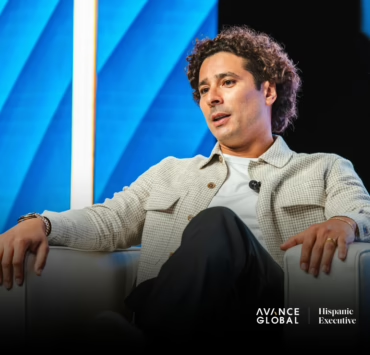

Recorded at AVANCE Global 2026 in Las Vegas.
“She didn’t speak very much. She was all about action and work.”
That’s how Fernando De Leon remembers his grandmother, who was widowed in her twenties and left to raise seven children. She was tough, he says, and she was also one of his earliest examples of what work looked like.
De Leon grew up between Matamoros and Brownsville. He lost his father at twelve, and money at home became so scarce that he remembers eating tortillas with butter for breakfast, lunch, and dinner. By thirteen, he was already working as a translator for American developers doing business in Mexico.
That early work also gave him his first lesson in ownership. After helping solve a problem for a real estate developer, De Leon could have simply collected a fee for his work. Instead, he asked how much of the project the developer would be willing to give up in exchange for solving it. The answer: somewhere between five and ten percent.
De Leon chose the middle.
“I said, and I’ll take seven and a half percent. Not five, not ten, seven and a half.”
What began as an early lesson would eventually become a career. Today, De Leon is the founder and CEO of Leon Capital Group, a holding company with twelve independently managed subsidiaries spanning financial services, healthcare, and real estate. His real estate investments exceed $15 billion in asset value, while his healthcare companies operate more than 600 locations.
But when De Leon sat down with Pedro Guerrero on the Hispanic Executive set at AVANCE Global 2026 in Las Vegas, the conversation was not simply about what he had built. It was about what comes next and, specifically, what it would take for more Latinos to build and own at scale.
“We’re hardworking people, and now we need to be owners.”
For De Leon, that distinction matters. Capital, he argues, works like any other supply chain: it has sources, intermediaries, distribution, and access. And Latino participation in that system has yet to reflect the community’s economic footprint.
“There’s a supply chain to capital and Latinos need access to that supply chain.”
His argument is not that Latinos need to work more. It is that work alone is not the finish line. The next step is turning that work into assets, businesses, property, and equity.
“Because when you own things, businesses, property, you have relevance and you have influence.”
It is a lesson De Leon learned unusually early: sometimes the more consequential choice is not getting paid for the value you create, but owning a piece of it.
“We need Latinos to own stuff.”