


In Latin American futbol, superstition is not an accessory. It’s practically a starting player.
There are the players, the coach, the fitness staff, and a person who cannot move from the couch because “that’s where we were sitting when we scored last time”, they all play together.
At first glance, all of this seems irrational. And, well, it is. But it’s not irrational in just any way. It’s irrationality with rigorous method, memory, and a very reasonable human need: to feel like we’re doing something when we can’t do anything at all.
Psychologist Ellen Langer called this the illusion of control: our tendency to overestimate our ability to influence outcomes that are actually beyond our control. In sports, the formula is perfect. The desire for something to happen is enormous, while our actual ability to intervene is, even with some exaggeration, basically zero. Research on superstition has also found that we seek out lucky objects and rituals when we want to control something we simply cannot control.
Put differently: nobody rationally believes that a jersey, a duck, or a freezer can change a scoreline. But the body and mind need a job to do.
Argentina: Anulo Mufa
Argentina solved the problem with two words:
“Anulo mufa.”
The phrase became a national ritual during Qatar 2022 and works as a kind of verbal fire extinguisher. If someone says, “We’re already champions,” or “This match is going to be easy,” another Argentine will immediately appear to cancel the statement before it causes damage through overconfidence.
Before it jinxes the game, in other words.
It doesn’t matter whether you believe in it or not.
What matters is avoiding unnecessary risks.
Because if there is even the slightest possibility that a poorly timed sentence could alter the fate of the national team, it’s probably better not to find out.
Mexico: The Soccer Baby Jesus and Merlin the Duck
Mexico took a different route.
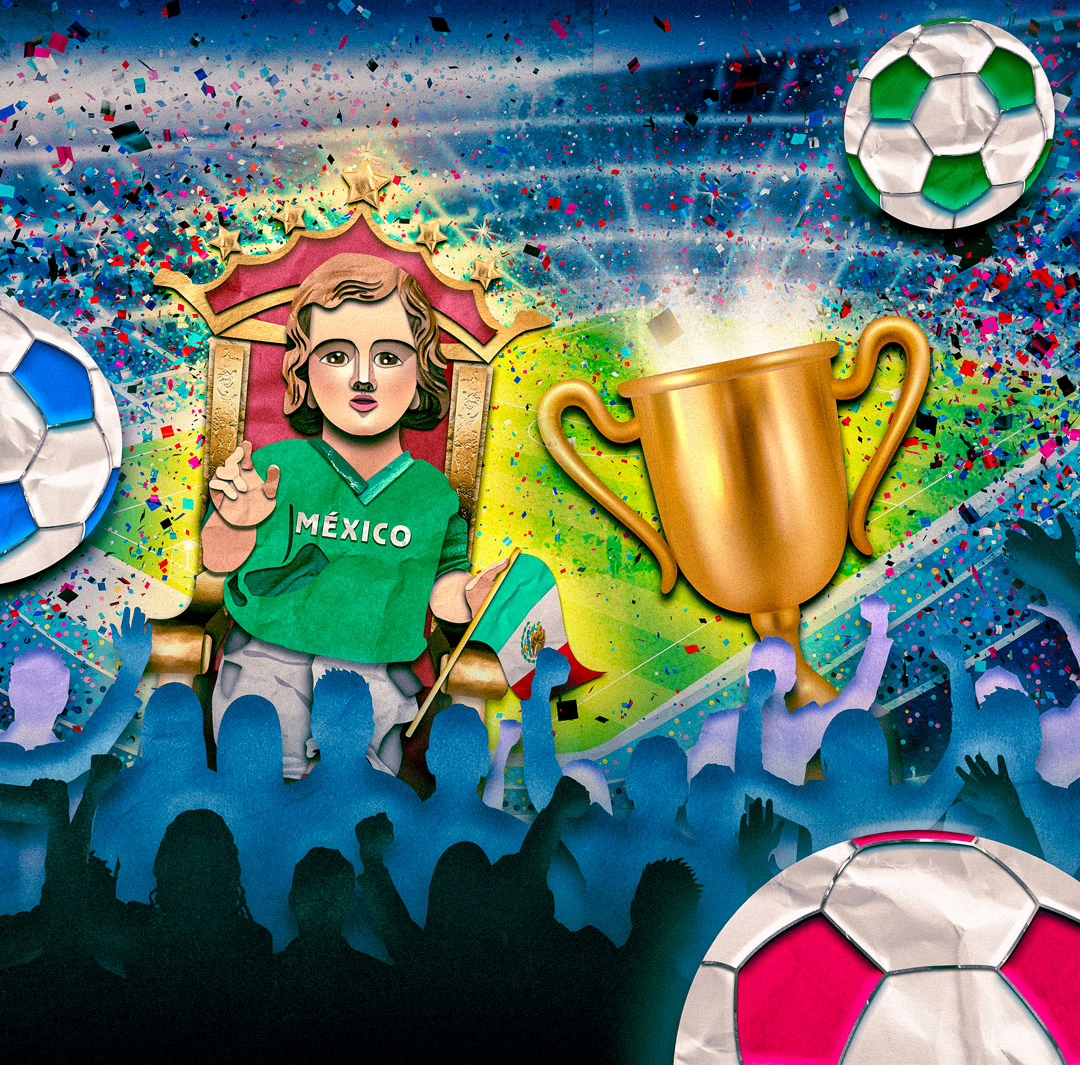
At Mexico City’s Metropolitan Cathedral, there is a tradition associated with the Niño Futbolista: a Baby Jesus figure dressed in the Mexican national team kit that some fans turn to for help during World Cups.
So far, this all sounds relatively normal by Latin American standards.
Then Merlin the Duck showed up.
An actual duck.
Wearing a Mexico jersey.
During this World Cup, Merlin went from accompanying his owners through the streets of Mexico City’s historic center (a city of more than 22 million people), to becoming a viral celebrity, photographed by fans and embraced as though he, too, might have something to contribute to El Tri’s performance.
Brazil: Freezing the Opponent
Brazil offers perhaps the most practical solution of them all: freeze the opponent.
Not tactically. Not strategically.
Literally.
During several World Cups, fans have been documented writing the name of the opposing team on a piece of paper and placing it in the freezer before kickoff.
The logic is impeccable.
If you can’t stop the opposing striker, at least you can keep him at a controlled temperature.
It’s difficult to imagine what goes through a person’s mind while placing the name of Germany or Argentina next to a bag of ice and a tray of frozen chicken.
Then again, they are the only five-time world champions.
Maybe they know something we don’t.
Ecuador: The Coin in the Shoe
Ecuador contributes one of the most elegant superstitions in this collection:
A coin inside the shoe.
Not in your pocket.
Not in your wallet.
Inside your shoe.
The beauty of this ritual is that it stays with the fan throughout the entire match. Every step becomes a small reminder that luck is putting in overtime.
And while nobody can explain exactly how a coin hidden near your toes might influence an international football match, nobody can definitively prove that it doesn’t.
That has always been my favorite territory of superstition.
Because maybe, if we think about it for a moment, these rituals never existed to help the team.
Maybe they always existed to help us.
Research on rituals shows that repeating certain actions can reduce anxiety in uncertain situations. And few things create more uncertainty than emotionally investing yourself in eleven people you’ve never met.
That’s why we keep using the same chair, folding the jersey the night before, repeating the same rituals, and holding on to objects that, rationally, we know change nothing.
Because futbol leaves us powerless.
And superstition, however absurd it may seem, gives us back the feeling of having at least one finger on the steering wheel.
Or perhaps, more appropriately, one foot on the ball.

