
The last few days, much of Latin America celebrated Día del Niño, Children’s Day. And if there’s one thing every Latino kid has experienced, without exception, trust me on this, it’s the art of falling asleep between two chairs at a family party.
Because in every Latino gathering, there’s a moment when the night stops operating under the normal laws of the world. Nobody knows exactly when it happens, but it happens. It could be after the cake, before the recalentado, or somewhere during the third round of songs that were definitely the last ones.
Everything becomes the party. And inside that party, the rules change. Food can appear at midnight. An aunt can dance with someone she just met. The only rule is that nobody questions what’s happening too closely.
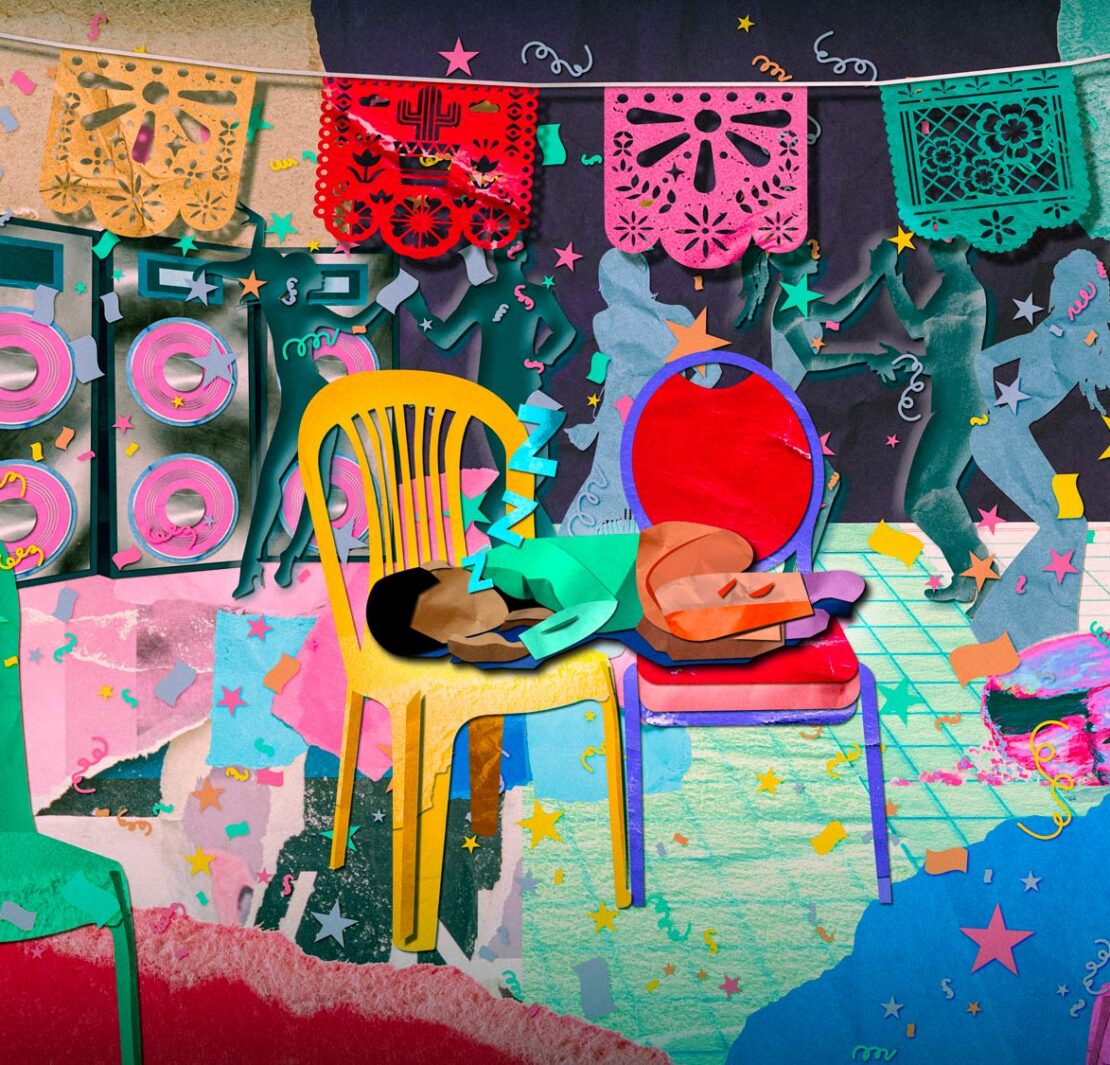
And there, in that beautiful limbo of celebration, a child can fall asleep between two chairs. Not in a bed. Not on a couch. Not in any space that humanity has ever intentionally designed for rest. Between. Two. Chairs.
The scene is poetic: two chairs pushed together with remarkable architectural confidence. A sweater folded into a pillow. A tablecloth doubled up as a blanket. Music at full volume. Adults dancing all around. Someone walking by with a plate of food.
And the child, perfectly still. At peace. Like he’s at a resort.
For anyone who didn’t grow up with this, the image might look uncomfortable. For us, it’s a solution.
Which is exactly why, when Bad Bunny brought a wedding to the Super Bowl halftime stage and that image appeared: a child, sound asleep between two chairs in the middle of the chaos, it landed so perfectly. It wasn’t just a visual detail. It was a cultural password.
We saw it and we understood immediately. That child wasn’t abandoned. Quite the opposite, actually. He was in familiar territory.
The anthropologist Victor Turner wrote about liminality: that in-between state where you’re suspended between categories. Neither here nor there. Neither one thing nor the other. A space where normal rules loosen and a different kind of community takes shape.
He probably wasn’t thinking about a child asleep between two chairs while “Suavemente” by Elvis Crespo plays in the background. But honestly he could have been.
Because that image is profoundly liminal. The child isn’t awake, but he’s not entirely gone either. He’s not at the party, but he’s not outside of it. He’s right in the middle of everything.
That’s one of the great talents of our parties: creating in-between spaces. Places where normal categories dissolve. The living room becomes a dance floor. The kitchen becomes a confessional. The entryway becomes emotional parking for forty-minute goodbyes. And yes, two chairs become a bed.
There’s something deeply Latino in that ability to adapt your body to the moment. To not demand that the environment change for you, but to find a way to keep belonging inside the chaos.
In other cultures, that might be the moment someone says: “Alright, I think it’s time to head out.” In many Latino families, that’s the moment someone says: “Acuéstalo ahí tantito.” Just lay him down there for a bit. Tantito, of course, can mean twenty minutes, three hours, or until someone finds their keys, but that’s a topic for another Hisplaining.
And nobody experiences it as a tragedy. Nobody turns down the music. Nobody stops the dancing. And nobody, absolutely nobody, says “what would Victor Turner think of this?” Though, honestly, he’d probably say it’s pretty clear.
Because what holds that scene together isn’t neglect. It’s trust. Trust that a child can sleep surrounded by noise because the noise isn’t a threat, it’s the atmosphere.
And maybe that’s why the image makes us laugh so hard. Because we recognize it too well. Because we were that child. Because even as adults, we’re still that child.
The kid asleep between two chairs isn’t a footnote to the chaos of a Latino party. He’s the philosophical center of it. Proof that sometimes, being home doesn’t mean being perfectly comfortable. It means being able to fall asleep anywhere.