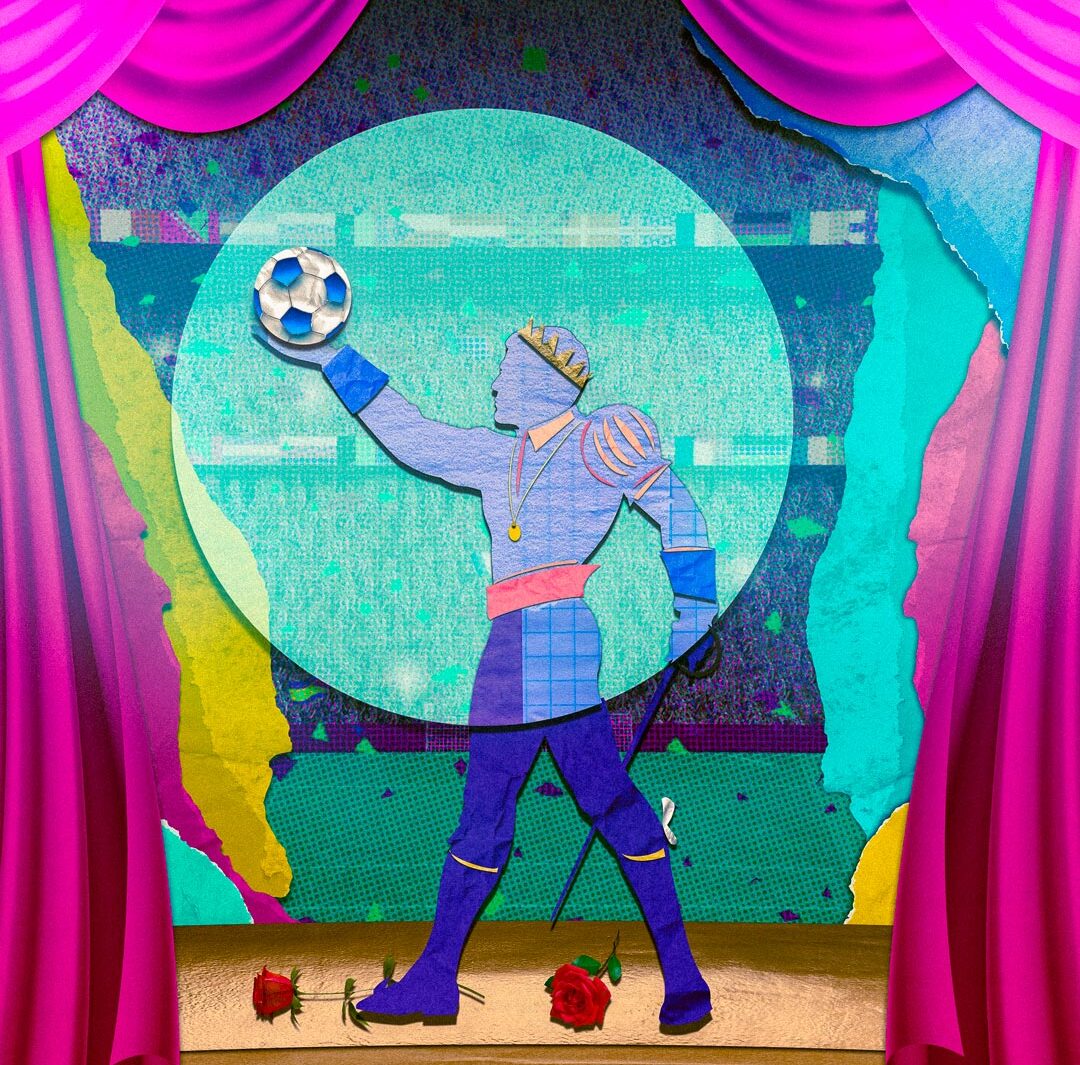

Some people watch a soccer match more or less like any other sporting event. Then there are Latino fans, who witness a five-act drama unfolding before their eyes.
It all begins with hope. The team walks onto the pitch, we sing the anthem, the opening whistle blows, and for a few glorious seconds the universe feels perfectly balanced. But all it takes is one misplaced pass for someone in the living room to declare, with the gravity of an actor on the Globe Theatre stage: “We’re not in this. We’re just not in this today.”
Three minutes have passed.
Not one more. Not one less.
This isn’t simply a cultural exaggeration. Psychology has quite a bit to say about it. Researchers such as Melanie Green and Timothy Brock describe a concept known as Narrative Transportation, which suggests that human beings don’t simply observe stories, we step inside them. Our minds instinctively organize events as narratives, complete with protagonists, antagonists, conflict, unexpected twists, and an ending that has yet to be written.
And few things offer a more perfect narrative structure than a soccer match.
There are heroes who rise precisely when they’re needed most. Villains whose names change every twenty minutes. Sacrifices. Redemption arcs. Decisions no one will ever fully understand. And moments when fate itself seems to be writing the script with an unmistakable flair for drama.
That’s why it’s far too boring to say, “Did you see that sitter he missed?”
We’d much rather declare, “He held the destiny of an entire nation at his feet… and chose to abandon us.”
Because we’re not really describing a play.
We’re telling a story.
And every great story demands tension.
Almost every family has, without realizing it, its own resident playwright. It’s the person capable of turning any routine sequence into a monologue worthy of classical tragedy, where every substitution carries symbolic meaning and every defensive mistake feels like the beginning of the final act.
But there’s another concept that helps explain why these narratives escalate so effortlessly. Appraisal Theory, developed by psychologist Richard Lazarus, argues that our emotions depend not only on what happens, but on how we interpret what happens.
In other words, the very same pass can mean completely different things depending on the story we’ve already begun telling ourselves.
If the team starts nervously, the next mistake stops being just a mistake and becomes a sign of destiny. If a clear chance is missed, it is no longer a wasted opportunity but the first chapter of an unavoidable tragedy. And if the opponent scores first, some fans are already mentally writing the opening scene of the documentary about yet another generation condemned to heartbreak.
What’s truly remarkable is how quickly the script can change.
One goal against transforms everyone into existential philosophers. Five minutes later comes the equalizer, and suddenly the very same team is once again destined to lift the trophy. No streaming platform changes genres quite that fast.
Soccer is rarely told through statistics alone. It’s told through characters, conflict, sacrifice, impossible comebacks, and dramatic plot twists. No one would ever say the cashier at the grocery store scanned their items heroically. Yet during a match, every tackle, every save, and every pass somehow earns the weight of an epic narrative.
Perhaps that’s one of the reasons soccer has always been so much more than a sport. For ninety minutes, we stop watching twenty-two people chase a ball and begin following a story whose ending remains unwritten. As long as uncertainty exists, our minds will keep composing dialogue, assigning heroes, searching for villains, and predicting tragedy long before halftime.
Because the match is played on the field.
But for Latino fans, Shakespeare probably would’ve asked to save him a seat on the living room couch.