

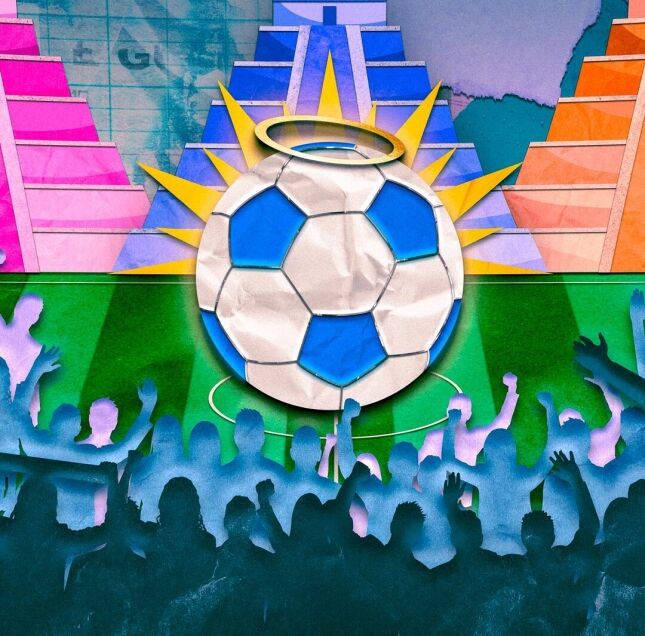

There is a difference between watching soccer and living futbol.
Soccer is a sport. Futbol, our futbol, is when an otherwise reasonable person decides that eleven complete strangers have permission to ruin their Sunday, alter the emotional climate of their household, and determine the mood of the entire week.
Because futbol is not just what happens on the field. It is everything that happens around it. It is the memory of a house filling up before kickoff. The food appearing right as the teams walk onto the pitch. The uncle who somehow becomes a world-class manager from the comfort of his couch.
That is where things get interesting.
Émile Durkheim, one of sociology’s most influential thinkers, wrote about something called collective effervescence: the energy that emerges when large groups of people gather, focus their attention on the same thing, and feel the same emotions at the same time. Individual emotion becomes shared emotion. A “we” begins to emerge.
Durkheim was probably not thinking about a room full of Latinos yelling, “How do you miss that?” at a television. But he could have been.
Futbol has this remarkable ability to turn separate individuals into a single emotional organism. It is most visible in a stadium: thousands of voices singing the same chants, hands raised at the same moment, insults delivered with a level of synchronization that would make a Broadway choreographer proud.
But it also happens at home, in the office, at a restaurant, or around a phone screen secretly shared between a few during a meeting that could have been an email.
Talking about that… Just a quick note to all the corporate America managers reading this: between June 11 and July 19, please keep meetings to an absolute minimum. Thank you for your cooperation.

Futbol creates instant community. It is not always elegant, refined, or peaceful. But it is community nonetheless.
And maybe that is why it matters so much. The match allows us to feel something together. It gives us a common language. An emotional calendar. A socially acceptable excuse to yell, hug, suffer, swear we no longer care, and then come back for more the following Sunday… or the next World Cup.
It also gives us memory.
Everyone remembers where they were for certain goals. Who they watched them with. What they were eating. Who cried. Who got angry. Futbol organizes memory like very few things can.
And in many Latino families, those memories are inherited. Not through formal instruction. Nobody sits you down and solemnly explains the history of a team. One day you simply find yourself there, wearing a jersey that is much too large, watching adults behave in ways that seem mildly concerning, until a goal is scored and suddenly you understand everything without anyone having to explain it.
That is the moment futbol stops being soccer. It becomes belonging.
None of us cry simply because a striker missed an open net. We cry for childhood. For family. For the neighborhood. For the country. For the food. For our people. For the team we chose, or, more likely, the one that was inherited without our consent.
We cry because, for ninety minutes, all of those things become visible.
That is why futbol for Latinos is never just soccer. It is gathering, memory, identity, superstition, inheritance, family debate, and group therapy without the presence of a licensed moderator.
It is collective effervescence with a sports commentator.
Proof that there are still moments when millions of people can feel the same thing at the same time.
Even if that thing is anxiety.
Especially if it is anxiety.
The world’s biggest party has officially begun, and with it, Hisplaining is getting ready to explore some of the most fascinating behaviors in human existence: Argentine superstitions, Brazil’s obsession with turning futbol into art, and, of course, the extraordinary ability of more than 160 million Mexicans to ignore every available piece of historical evidence every four years and believe that maybe, just maybe, this is finally our year. Starting, naturally, with the person writing these lines.
And if there is one thing we have learned here, it is that the best stories begin when people stop behaving completely rationally. Join us as we Hisplain the many ways Latinos live futbol over the next six weeks.

