

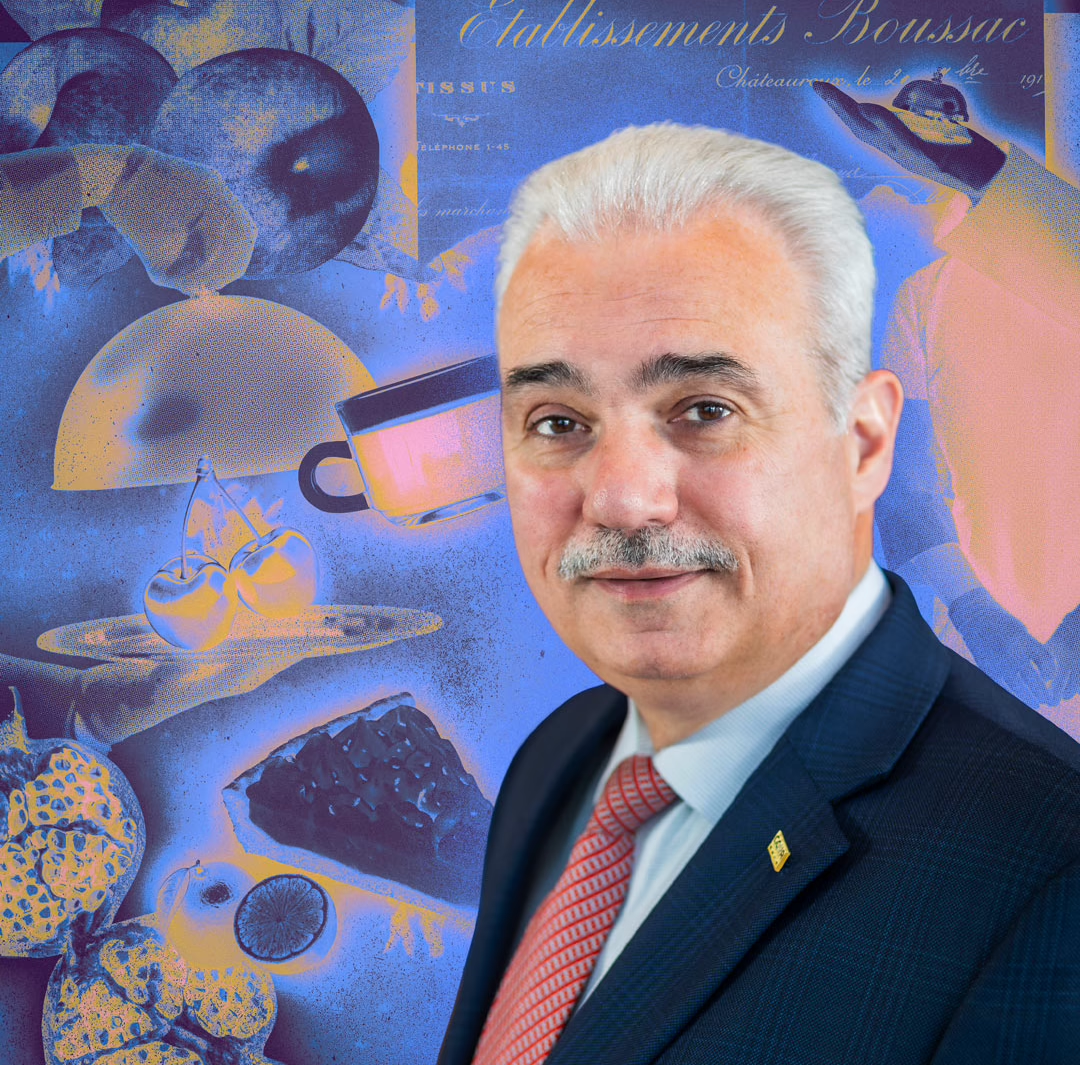

Thirteen years after Tony Rico first introduced readers to “La Gran Familia Goya,” the director of human resources has helped enable growth at Goya Foods, the largest Hispanic-owned food company in the United States.
“The title on my business card hasn’t changed much,” Rico says. “The size of the ‘familia’ I feel responsible for, that’s what’s changed.”
When Hispanic Executive last caught up with Rico in 2013, he had already begun modernizing HR systems, centralizing functions like logistics and quality control. That philosophy has been tested by crises he could not have imagined all those years ago: a global pandemic, a constantly shifting immigration landscape, and the relentless growth of a brand that now offers roughly 2,500 products tailored to different communities across the country.

HR Driving Culture & Care
Over the past twenty-two years, Rico has led a structural transformation of how Goya takes care of its people for the long term. He shepherded the company’s move away from a traditional retirement plan to a 401(k).
“We started our 401(k) with about $6 million,” the director says. “Last November, we broke a $100 million. That’s not just a number; that’s retirement money for our family’s family.”
The HR leader and his team still hit every facility at least annually to sit down with employees in person, walking them through contribution options and encouraging them to invest more meaningful savings.
Inside the plants, he has pushed just as hard on safety and preparedness. A previously decentralized approach is now a unified safety structure with standard protocols and annual walk‑throughs that look the same across twelve Goya facilities in the continental USA. Safety measures, including CPR training, have been implemented organization-wide.

Rico has pushed hard for workforce development, particularly for frontline employees who may not see themselves as corporate material. He has grown partnerships with local colleges and universities, including Hudson County Community College, Felician University, and, possibly soon, Saint Peter’s University.
“We bring college-credit ESL classes for our production, warehouses, and office employees. Our employees can learn onsite,” Rico says. “They’re enhancing their skills, and we’re enhancing ours. We’re growing our own future leaders.”
“We work hard to provide growth opportunities from within for those who work hard, show an interest, and are interested in improving their skills. We provide additional instruction employees may not be able to get or afford on the open market.” In parallel, Rico takes his own HR staff and other high-potential employees on visits to distant facilities where they troubleshoot real problems, share meals with local teams, and learn on the job.
“I’ve got greenhorns who know the HR book but don’t know reality,” Rico says with affection. “So, I take them on field trips to different facilities. They learn Goya culture at the dinner table alongside other general managers, not in a classroom.”
Advertisement
Scaling in Stressful Times
The director has been critical in helping Goya scale its physical footprint without losing what makes it great along the way. As the company has added facilities and expanded into ever more SKUs, about 2,500 products tailored to local demographics, he has helped refine a leadership model that promotes from within.
Long-tenured employees who have rotated through sales, purchasing, and operations are groomed into general managers of new sites, then supported by developed number-two and number-three leaders. A small group of troubleshooters—a team he affectionately calls “the fire department”—is ready to fly out and support facilities in distress, ensuring that when Goya breaks ground in a new market, its culture lands intact.
On the compliance front, Rico tries to anticipate and respond to compliance and enforcement issues. He very much believes in staying current and ensuring the team under him is current on trends. For example, well before the current administration evidenced an interest in immigration and I-9 compliance, Rico had already instituted recurring self-audits of I-9 documentation. As the lead HR representative for a company that straddles complex borders, he has been instrumental in trying to facilitate visa assistance for those employees who may be facing work visas or work authorizations that may be expiring in the near future.
There were herculean stress tests, like the COVID-19 pandemic, when food manufacturers were deemed critical infrastructure, and there was no option for frontline employees to work from home. Rico helped manage the rotations, quarantines, and staffing gaps required to keep lines running while the virus tore through communities, and he still speaks of that period with a mix of exhaustion and gratitude.
“The pandemic was an incredibly challenging time for all of our people here,” the director says. “But we needed to get cans on shelves for other families we knew were struggling. We took every precaution we could and got to work. I don’t think people ever stop to think about what it takes to get a can on a shelf, but the pandemic was an incredibly challenging time. I’m proud of how this organization moved through it.”
Rico is the kind of leader you want in challenging times. While working at the Port Authority of New York and New Jersey, the first World Trade Center bombing occurred in 1993. While evacuating the building, Rico remembers security not recognizing him, his face blackened by soot and dust.
Whether it taught him how to manage a crisis or was simply a reflection of his own expertise, Rico says it was the first time that he understood how he operated in a situation that might cause others panic. That’s not his style. An emergency tends to sharpen his reflexes and slow down time.
La Gran Familia
The reason Rico has stayed loyal to Goya was touched upon previously, but as the years go by, there’s more to celebrate. More than two decades ago, his twin daughters were born extremely premature; Tara, the smaller of the two, weighed just thirteen ounces and was given a 5 percent chance of making it through her first night.
Rico shows a ring that once slipped up her entire leg in the NICU. Her sister, Sara, passed away on Christmas Eve. Tara survived nine months in the hospital and came home with a long list of surgeries, complications, and a need for twenty-four-hour nursing care. At the time, Rico was climbing the ranks of large New York organizations, commuting up to two hours each way and fielding calls from nurses. He needed to be able to be home.
It was at this point that his life intersected with Goya. Then-president Bob Unanue listened to Rico’s story, studied a photo of Tara covered in wires in the NICU, and made an offer. “Bob said, ‘You have a child with special needs, we understand that because the same goes for my own family. Here is a deal: You take care of the employees, and we’re going to take care of you, your daughter, and your family.’”
Tara will graduate with honors in May 2026 and is considering law school.
That legacy continues with Rico’s son, Tony Jr., a high school junior who’s currently being scouted by universities for his bowling skills. Rico’s pride is quite evident.
Rico expresses gratitude to his wife Elena, a Doctor of Pharmacy and his partner for thirty-three years. He credits her with saving their daughter, having benefitted from experimental respiratory treatment that his wife helped trailblaze.
Goya has continued to be there when it mattered most.
“I am honored to have partnered with Tony for 22+ years,” says Chris Reynen, VP of Alliant Employee Benefits. “Anyone who has spent time with him can confidently state he’s incredibly dedicated to providing the highest quality product that he and his department can create. He works thoughtfully with all around him to achieve lofty goals by challenging each to perform at their best. His attention to detail is refreshing in current times when most people are multi-tasking and not providing the concentration needed for matters-at-hand. If asked for the penultimate tour guide of Goya facilities, I would not hesitate to nominate Tony. His attention to detail is very apparent when guiding a Goya warehouse tour with amazed visitors. Tony can speak not only about Goya’s history but can also intimately explain anything about Goya’s operations and the merchandise seen on such a tour.”
Reynen adds: “At Alliant, we feel one of his best accomplishments is the impressive culture he has built in the Goya Foods Human Resources department. It is a department that strives to satisfy “La Gran Familia Goya” with education and a myriad of assistance. Plus, his department has been known to pull a prank or two in the course of work that keeps matters lighthearted. We also deeply admire another side of Tony: a caring and committed family man who is generous to his surrounding community.”
Most recently, when Rico’s mother passed away, the funeral was flush with Goya employees. No mandatory memo was sent out. That’s just the culture that Rico has helped nurture and build. That’s a culture that scales, and one that remains loyal in the toughest moments. Rico came because of it and has made it flourish in real and lasting ways.
Alliant Employee Benefits helps employers navigate the increasing complexity of healthcare, workforce wellbeing, and benefits strategy in a rapidly evolving business environment. Rising healthcare costs, regulatory pressures, workforce expectations, and the need for innovative cost management strategies require more than transactional brokerage support. As one of the nation’s leading employee benefits advisory firms, Alliant combines deep consulting expertise, analytics, clinical insight, and specialized resources to help organizations design tailored strategies that improve outcomes for both employers and their people. Through a collaborative, client-focused approach, Alliant delivers the perspective, partnership, and performance needed to meet today’s challenges and tomorrow’s opportunities.
Prioritizing risk management is crucial as investors seek informed strategies to help them preserve their wealth. At Morgan Stanley, we have the experience, knowledge and resources necessary to help you manage risk, understand its potential impact on your portfolio, and strive to work toward minimizing its effects. Let us help you protect your wealth — meet with me to learn how.
Tasha Garcia CEPA
Insurance Planning Director Associate Vice President Financial Advisor
150 John F Kennedy Pkwy (Fl. 2) | Short Hills, NJ 07078
Telephone: +1 973 921-6519
Email: [email protected]
NMLS #1760552
DISCLOSURE: Morgan Stanley recommends that investors independently evaluate particular investments and strategies and encourages investors to seek the advice of a Financial Advisor. The appropriateness of a particular investment or strategy will depend on an investor’s individual circumstances and objectives.

