

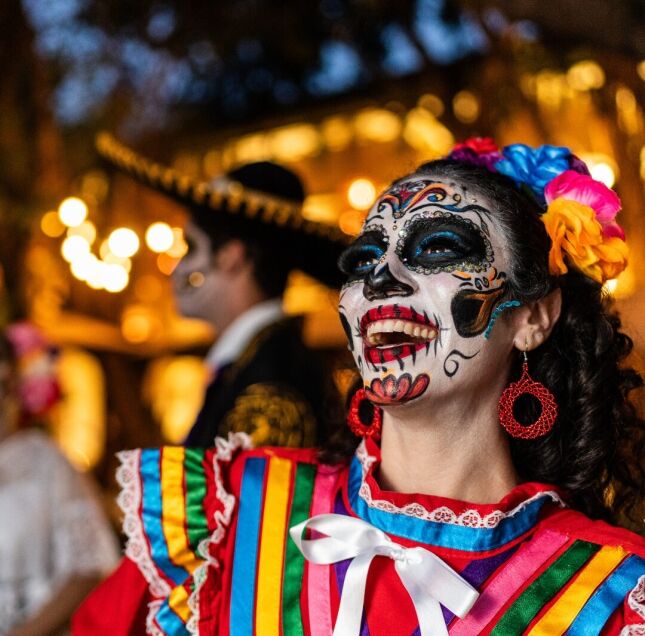

The elegant skeleton beneath the feathered hat looks timeless. Yet La Catrina, one of Día de Muertos’ most recognizable figures, emerged from the world of Mexican printmaking in the early twentieth century.
Her story offers a way into the celebration itself. The flowers, food, candles, and familiar faces gathered on an ofrenda carry histories shaped across generations. Understanding how they came together reveals a tradition sustained by the people who continue to give it meaning.
Before the November Calendar
Long before Spanish colonization, Indigenous peoples in Mesoamerica maintained ritual relationships with their ancestors. Offerings included incense and food, among them tamales, according to Harvard’s Peabody Museum.
Those practices provide important historical context, though tracing an uninterrupted line from ancient ceremonies to today’s celebration is more complicated. Anthropologist Stanley Brandes challenged interpretations that treat similarities in imagery as sufficient proof of continuity.
During the colonial period, Indigenous practices encountered Catholic observances brought by the Spanish: All Saints’ Day on November 1 and All Souls’ Day on November 2. Across communities, beliefs and rituals were reinterpreted under colonial religious rule, producing forms of remembrance that continued to change.
The November dates belong to that Catholic calendar. The ways families observe them reflect much more varied histories.
How La Catrina Entered the Picture
The celebration’s visual language also developed over time. In nineteenth-century Mexico, printmakers and publishers used skeletal figures in popular illustrations and satire.
Printmaker José Guadalupe Posada created the image that would become La Catrina. Its circulation through inexpensive printed sheets placed it within a world of popular storytelling, humor, and social commentary.
The name has its own history. Research highlighted by the Instituto Nacional de Antropología e Historia traces the title “Calavera catrina” to a 1930 collection of Posada’s work.
In 1947, muralist Diego Rivera incorporated the figure into Sueño de una tarde dominical en la Alameda Central, giving her the elaborate, full-length appearance familiar today. Her prominence grew through artists’ reinterpretations, helping turn a printed image into an enduring cultural symbol.
A New Public Life in the United States
Mexican American families observed traditions of remembrance well before the large public celebrations now held across the United States.
In the 1970s, Chicano artists and activists helped expand those observances into public expressions of cultural identity. Los Angeles arts organization Self Help Graphics & Art began its Día de los Muertos celebration in 1973.
As the Smithsonian American Art Museum documents, these events brought together altars, processions, and artwork while responding to concerns within Chicano communities. Remembering the dead also created space for people to gather, make art, and affirm their heritage.
The People Behind the Offering
Across these transformations, remembrance remains personal.
An ofrenda may hold a photograph, a favorite meal, or a drink prepared for someone whose place in the family endures. In the beliefs of participating communities, flowers and candles help welcome returning souls.
Practices differ by region and family. UNESCO’s recognition of the Indigenous festivities dedicated to the dead, originally proclaimed in 2003 and inscribed in 2008, acknowledges traditions that also connect remembrance with community life and the agricultural cycle.
That history continues whenever a family prepares an offering. Someone chooses the photograph. Someone remembers the recipe. Someone tells a child who the person in the picture was.

