

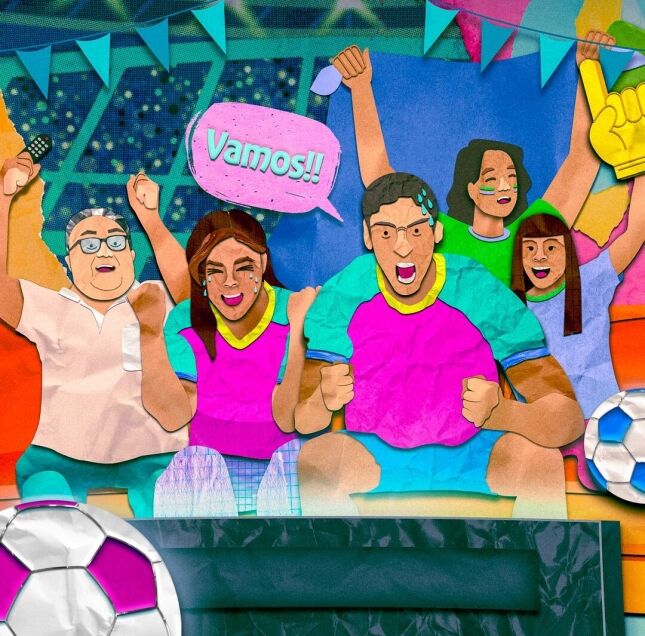

Hisplaining the Art of Watching the Game with Family: A Full-Contact Sport
Some people think a soccer match lasts 90 minutes. Clearly, they’ve never watched one with a Latino family.
Because the real competition begins long before kickoff: when someone claims the best spot on the couch, someone else asks who has the remote, and another family member announces they’re about to “explain” the starting lineup, even though nobody asked.
The funny thing is, sociology actually has quite a bit to say about this.
Experts in group dynamics under stress explain that when people experience an emotionally charged situation together, they naturally fall into specific roles. Nobody assigns them. They simply emerge.
And family gatherings, or even watch parties with friends, are a perfect example.
There’s the strategist, who questions every substitution the coach makes. There’s the unofficial commentator, providing play-by-play analysis as if the broadcast somehow needed a second announcer. There’s the optimist reminding everyone that “there’s still plenty of time,” while everyone else has already calculated twelve different qualification scenarios.
And then there’s the person who decides the new hydration break is the perfect moment to grab more snacks… only to return just in time to hear everyone screaming about the goal they missed.
But perhaps the most fascinating role is the official person to blame. Because when a team loses, we rarely accept that they were simply outplayed. It’s much easier to find an explanation somewhere in the living room.
“Everything changed the moment you got up.”
“Who changed the channel earlier?”
“See? You started talking right before the penalty.”
Nobody admits it, but every family has an unofficial committee responsible for assigning blame.
The interesting part is that it almost never has anything to do with soccer.
It has everything to do with the group.
Another concept that helps explain this ritual is emotional contagion. Emotions don’t stay contained within individuals. They spread.
When someone jumps up celebrating a goal, everyone nearby is likely to raise their voices, smile, or leap off the couch almost instinctively. In the same way, one missed chance can turn a room full of conversation into complete silence within seconds.
Emotions travel remarkably fast among people sharing the same experience.
That’s why watching a game alone and watching it with others are two completely different experiences.
The scoreboard is the same, but the intensity isn’t.
And the more people there are, the more unpredictable the atmosphere becomes. Suddenly everyone is talking, nobody is listening, and everyone is convinced they’re right.
And somehow, that conversation still works.
It’s a peculiar kind of perfectly organized chaos. Maybe that’s why living rooms during major matches feel like miniature social laboratories.
Within a few square feet, leadership emerges, negotiations unfold, temporary alliances form, disagreements surface, collective celebrations erupt, and every now and then, someone slips in a complaint they’ve quietly been saving for months, waiting for the perfect opportunity.
All because of a ball that’s being kicked hundreds, or even thousands, of miles away.
In the end, the result matters. Of course it does. Just ask us Mexicans after last Sunday’s match against England.
But what really stays with us are the moments that repeat themselves generation after generation, World Cup after World Cup: the debate over the TV volume, the uncle who insists soccer was better in his day, the cousin who calls the match like they’re auditioning for a sports network, and the family member quietly clearing the dishes while everyone else is still dissecting the final play.
Maybe that’s why watching soccer with family has never been just about watching soccer.
It’s about taking part in a tradition where everyone instinctively plays a role they already know by heart, even though nobody ever handed out a script or held auditions.
Because the game is played on the field.
But for Latino families, the real full-contact sport has always been sharing the couch.

