Las Vegas likes origin stories.
There is Bugsy Siegel and the Flamingo. The Rat Pack. Howard Hughes. Steve Wynn. The invention of the megaresort.
But start the clock earlier and another history appears, one in which Latino contributions are not an addition to the Las Vegas story. They are present almost from the beginning.
Before Las Vegas Had Casinos, a Mexican Scout Found the Shortcut
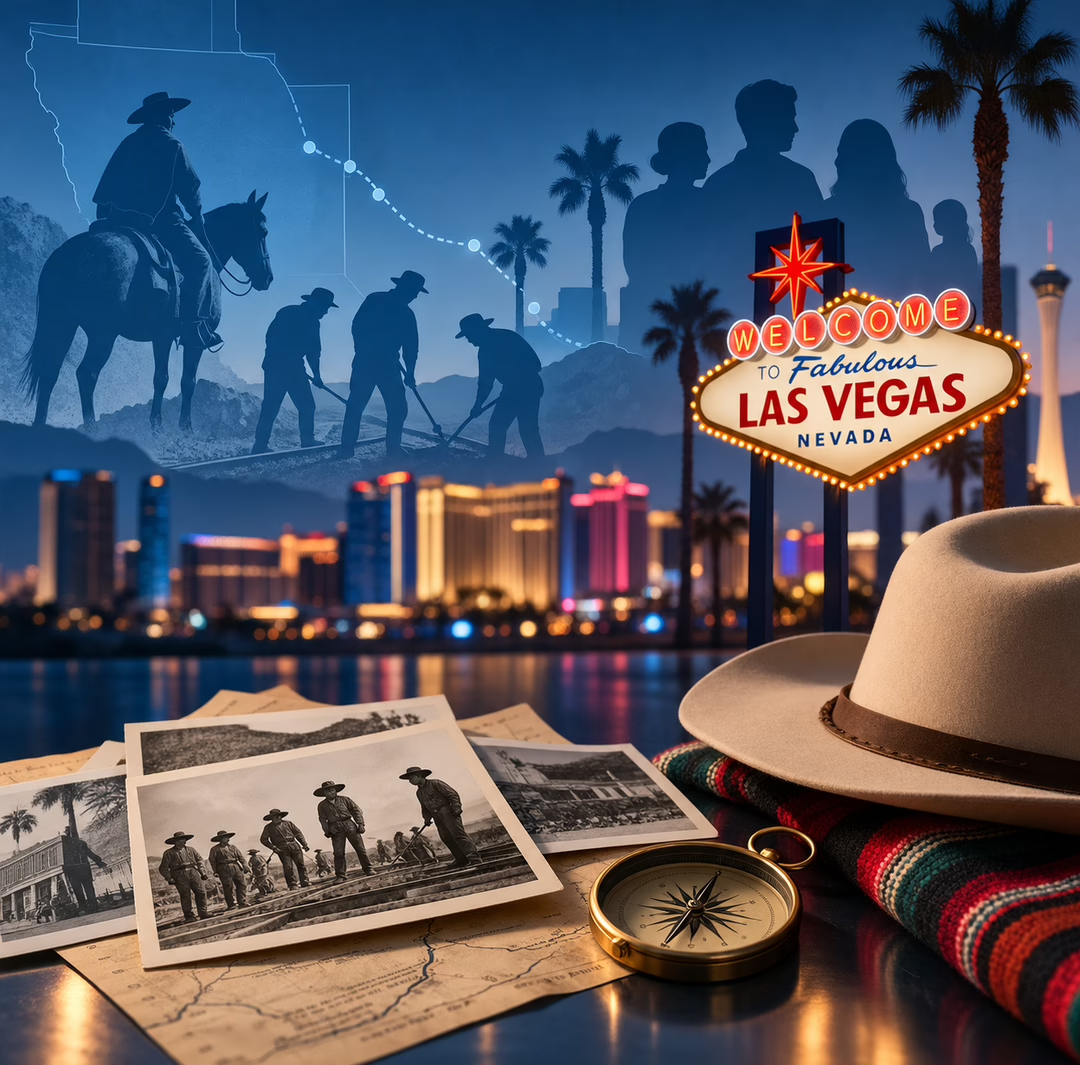
In 1829, nearly eight decades before Las Vegas became a city, Mexican merchant Antonio Armijo left New Mexico with roughly sixty men and 100 mules attempting to establish a trade route to Los Angeles.
One of his scouts, Rafael Rivera, separated from the caravan and reached the Las Vegas Springs around January 1830. His route helped establish a shorter passage through what became the Old Spanish Trail, transforming the springs into an important stopping point between Santa Fe and Southern California.
Today, Las Vegas has a street, park, and community center bearing Rivera’s name. But perhaps the more interesting legacy is geographical: one of the earliest documented routes bringing outsiders through the valley was mapped by a Mexican traveler.
In other words, Latino history in Las Vegas predates Las Vegas.
Then Came the Railroad and Mexican Workers Helped Build the Town
Modern Las Vegas emerged because of the railroad.
The San Pedro, Los Angeles & Salt Lake Railroad reached the valley in the early twentieth century; its construction led directly to the creation of the Las Vegas townsite and the famous 1905 land auction generally associated with the city’s founding.
Mexican workers were already there.
Historical research preserved at UNLV notes that Mexicans worked on local railroad crews as early as 1905, and Census records show substantial Mexican participation in the railroad workforce by 1910. Migration increased during the Mexican Revolution as workers came north seeking economic opportunity.
Their presence was significant enough that a Las Vegas Land & Water Company official complained in 1909 that the town’s Mexican and other minority populations were growing rapidly while discussing attempts to geographically segregate residents.
It is an uncomfortable detail, but an important one: Latino workers weren’t watching Las Vegas take shape from the sidelines. They were part of the workforce building the infrastructure around which the city grew.
The East Side Became Its Own Latino Las Vegas
The next major chapter arrived after World War II.
Mexican communities expanded, Cuban migration increased during the 1960s and 1970s, and Salvadoran migration later added another major population to what became known locally as Las Vegas’s East Side. UNLV research identifies Mexican, Salvadoran, and Cuban communities as particularly important to the area’s development.
Community institutions followed.
The Nevada Association of Latin Americans formed in 1969. Then, in 1976, Cuban immigrants Otto Merida and architect Arturo Cambeiro founded the Latin Chamber of Commerce, initially helping Latino entrepreneurs obtain financing and establish businesses.
That is another Las Vegas story hiding behind the Strip: while casinos were growing vertically, Latino communities were building economic infrastructure horizontally: business networks, civic organizations, neighborhoods, and institutions.
And Behind the Neon, Latino Workers Changed the Economics of Hospitality
Perhaps nowhere is Latino influence more visible than in the workforce that powers Las Vegas itself.
The Culinary Workers Union Local 226 became one of the most consequential labor institutions in the city’s hospitality industry. As casino expansion accelerated, the union increasingly recruited internationally and built a membership reflective of Las Vegas’s immigrant workforce.
One remarkable trajectory belongs to Geoconda Argüello-Kline, who fled Nicaragua in 1979, eventually moved to Las Vegas, and spent seven years cleaning hotel rooms before becoming an organizer. In 2012, a decade after becoming the union’s first Latina president, she was elected secretary-treasurer, its highest office. She had earlier been a lead organizer in the legendary Frontier strike, which stretched six years, four months, and ten days.
That journey—from guest-room attendant to leading one of Nevada’s most powerful labor organizations—feels particularly Las Vegas: reinvention, ambition, and scale.
The Bottom Line
Today, 32.8 percent of Clark County identifies as Hispanic or Latino. But the numbers alone miss the more interesting story.
Long before Latino leaders arrive for AVANCE Global, Latinos were already helping map Las Vegas, build it, organize it, work its resorts, create its businesses, and redefine who could exercise power inside the city.
Vegas may be famous for reinvention.
Latinos have been part of that reinvention for nearly two centuries.