

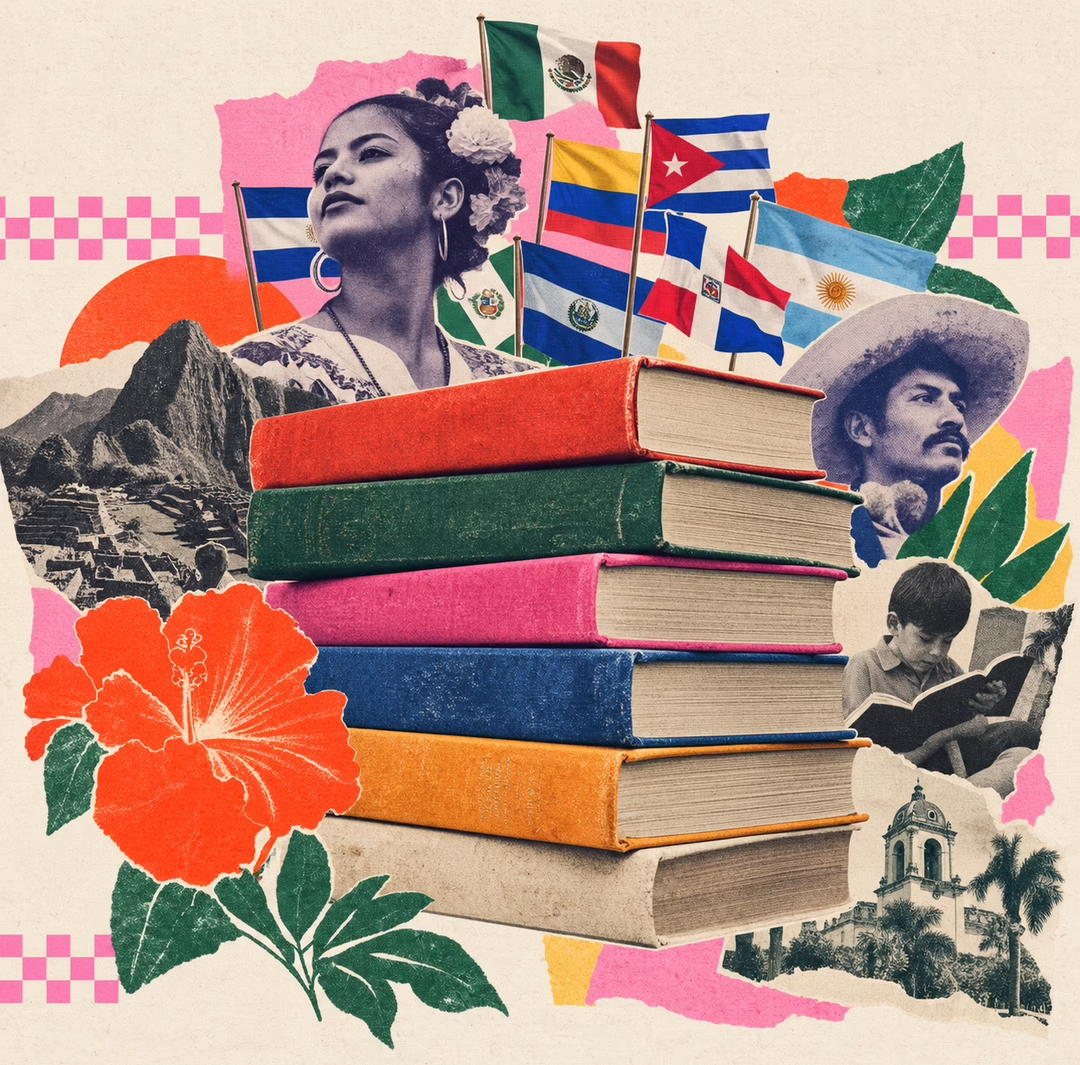

Latino history stretches across borders that moved around people, migration shaped by wars and economies, labor movements, city neighborhoods, racial identities, music, fashion, and families whose individual stories illuminate forces much larger than themselves.
The best books capture that complexity without sacrificing the thing that makes history worth reading in the first place: a good story.
Here are five places to start.
Harvest of Empire—Juan González
If you want the big picture, start here. Journalist Juan González connects five centuries of Latin American and US history to explain how Puerto Rican, Mexican, Cuban, Dominican, Central American, and other Latino communities came to occupy their particular places in the United States. But what keeps its 500-plus pages moving are the immigrant families woven throughout the history.
The central idea is compelling: Latino migration cannot be understood separately from the long economic and political relationship between the United States and Latin America.
Read it for: the history behind the demographics.
Barrio America—A. K. Sandoval-Strausz
Who brought American cities back?
Historian A. K. Sandoval-Strausz challenges a familiar story that credits young professionals and the “creative class” with the urban revival of the 1990s and 2000s. Through Chicago’s Little Village and Dallas’s Oak Cliff, he documents how Latino immigrants bought homes, opened businesses, repopulated neighborhoods, and restored street life after decades of population loss and disinvestment. The book combines statistics with extensive oral histories, giving the argument actual characters and neighborhoods.
Read it for: a different explanation of how modern American cities were rebuilt.
The Woman in the Zoot Suit—Catherine S. Ramírez
The zoot suit is an iconic piece of Mexican American history. The pachuca wearing one is much easier to overlook.
Catherine S. Ramírez puts Mexican American women back into the story of 1940s Los Angeles, examining the young women whose clothing, hairstyles, sexuality, and refusal to conform challenged expectations from both mainstream America and their own communities. It also revisits the Sleepy Lagoon case and the cultural politics surrounding the Zoot Suit era.
Read it for: fashion as a doorway into gender, identity, rebellion, and memory.
The Injustice Never Leaves You—Monica Muñoz Martinez
Some history survives because institutions preserve it. Other history survives because families refuse to forget.
Monica Muñoz Martinez investigates anti-Mexican violence along the Texas-Mexico border between 1910 and 1920, including killings committed by law enforcement and vigilantes. What makes the book especially fascinating is its second story: how official accounts minimized that violence while witnesses and descendants preserved memories across generations.
Read it for: understanding who gets to decide what becomes “history.”
My Beloved World—Sonia Sotomayor
Not every history book needs to look backward from a historian’s desk.
Sonia Sotomayor’s memoir takes readers from a Puerto Rican family in the Bronx through Princeton, Yale Law School, and her career before joining the US Supreme Court. The historical value lies in the specificity: family, language, class, education, ambition, and belonging experienced through one extraordinary life. Sotomayor became the first Latina to serve on the Supreme Court in 2009.
Read it for: American history at human scale.
The Bottom Line
Hispanic Heritage Month can easily become an exercise in looking backward. These books make history useful for the opposite reason.
They complicate familiar stories about who built American cities, who shaped its institutions, how its borders came to matter, and whose experiences made it into the official record.
The best history rarely feels like memorizing the past.
It feels like discovering why the present looks the way it does.

