
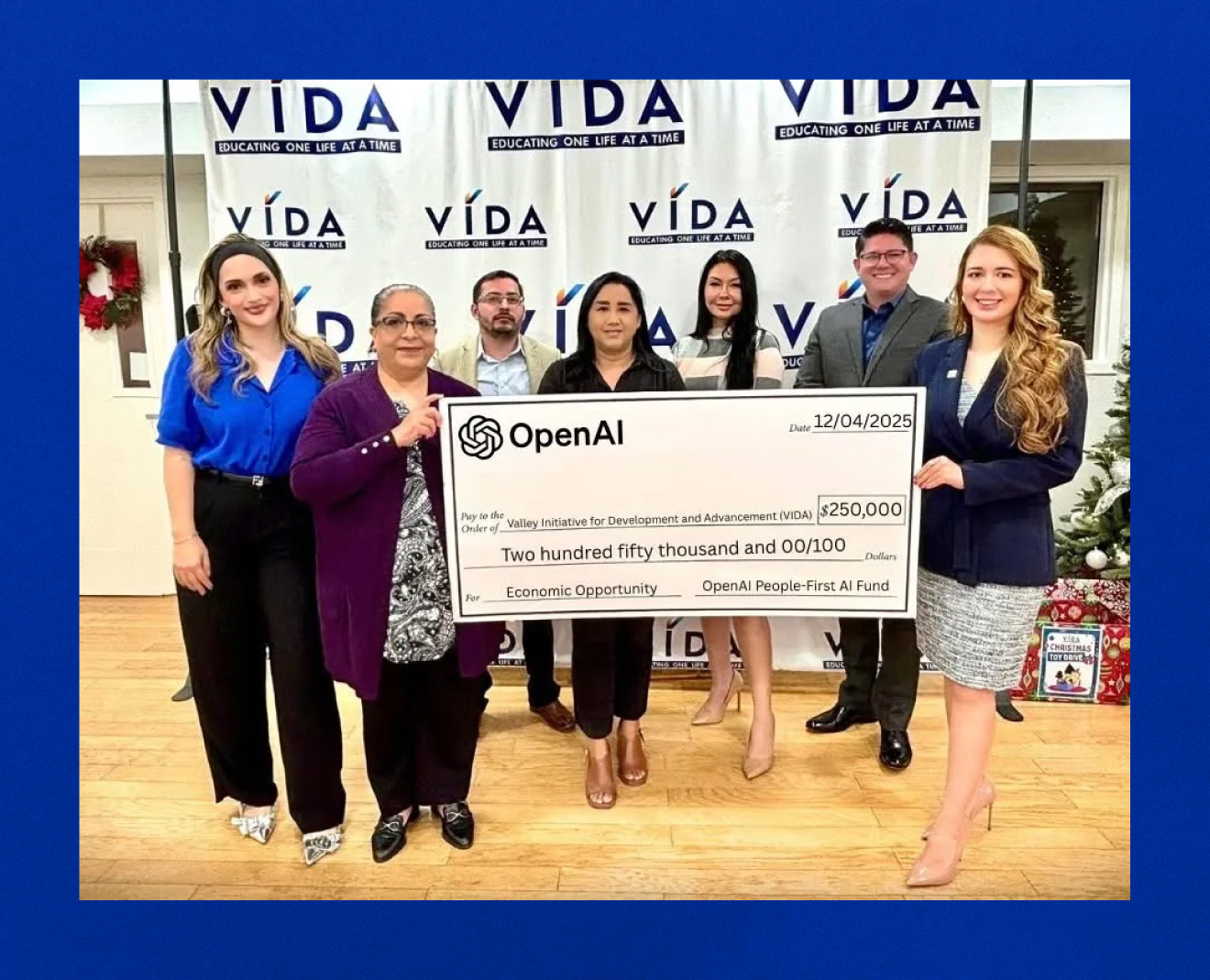
With a new grant from the OpenAI Foundation’s People-First AI Fund, Valley Initiative for Development and Advancement (VIDA) is committed to utilizing AI to enable economic opportunity for the people of the Rio Grande Valley.
The OpenAI People-First AI Fund was created to support nonprofits and highlight AI’s potential to create meaningful change in the lives of the nonprofits selected for the grant. The first open call drew more than 3,000 proposals from around the country and eventuated in 208 awards spread across journalism, civic tech, and workforce development.

VIDA was one of the few organizations outside of California to make the cut. The South Texas-centered workforce nonprofit works with a majority Hispanic, binational population, and may not come to mind as the first nonprofit to implement AI innovation.
“I think the organizations that are going to be best served by this grant are the ones who are willing to think differently and openly about how to serve their bases best,” says VIDA President and CEO Felida Villarreal. “This grant is not just going to allow us to continue serving our mission, but to expand some of our programs that have specific AI components.”
VIDA’s proposal was centered around AI literacy being critical for those at the community college, career-training, and workforce readiness level. At VIDA, that includes students studying nursing, welding, IT, engineering, business, and other in-demand fields.
Through established partnerships with UnidosUS, and Verizon edX, participants can earn microcredentials tied to universities like Harvard, Rice, and Columbia that focus on AI tools, remote collaboration, and navigating modern data platforms. A student might learn to insert AI into patient-education materials, troubleshoot smart manufacturing equipment, or manage a dispersed team long before they get their first promotion.
The OpenAI grant gives VIDA room to take what had been a promising layer on the side and make it part of the core. More students can access these credentials, advisors can more systematically assess digital skills, and AI‑focused content can show up earlier and more often in a participant’s journey, before they graduate, switch jobs, or make their next big career move.
Guardrails in an Era of Automation
The Valley has long lived with the seeming paradox of high poverty and underemployment but employers who say they struggle to find people prepared for higher‑skill, higher‑wage roles. VIDA has built its reputation trying to close that divide, using an intensive model that includes tuition support, help with books and transportation, and case managers who stick with students throughout their entire experience.
Layering AI into that model will ensure that a medical assistant, line supervisor, or entry-level IT worker understands enough about AI to recognize its uses, ideal prompts, and enable adaptation in their own careers. In that sense, the grant functions as a guardrail of sorts. Instead of AI simply happening to the Valley, VIDA is hoping to give residents a say in how they meet it.
VIDA’s long‑standing partnerships with South Texas College, Texas State Technical College, Texas Southmost College, and a regional‑wide allied health training alliance that brings together hospitals, colleges, and workforce boards mean that AI‑ready skills can move quickly from the classroom to the work environment. When graduates show up already comfortable navigating digital platforms and experimenting with new tools, employers have a wider foundation from which to build.
Why VIDA?
From the Foundation’s perspective, VIDA brought two important assets to the table: a clear sense of who it serves and a long record of results. Over three decades, the organization has helped thousands of low‑income Valley residents complete credentials and move into high‑demand careers, with recent cohorts boasting a 98 percent persistence rate and average graduate earnings north of $52,000.
That track record has drawn a widening circle of high‑profile backers. VIDA has secured support from the Texas Workforce Commission, the Texas Higher Education Coordinating Board’s Texas ACE initiative, Texas Mutual Insurance Company, the AEP Foundation, Methodist Healthcare Ministries, Hispanic Federation, and other regional and national funders focused on workforce, health equity, and economic mobility.
The OpenAI Foundation grant lands on top of this mix, a sign that national tech philanthropy now sees the Valley as a place where AI investments can move quickly into real classrooms and real careers.
VIDA By the Numbers
30+ years serving the Rio Grande Valley with intensive, wraparound workforce programs
879 participants served in 2025 with 98% persistence rate and average graduate earnings above $52,000
7,000+ residents supported over the life of the organization in completing credentials and entering high‑demand careers.