

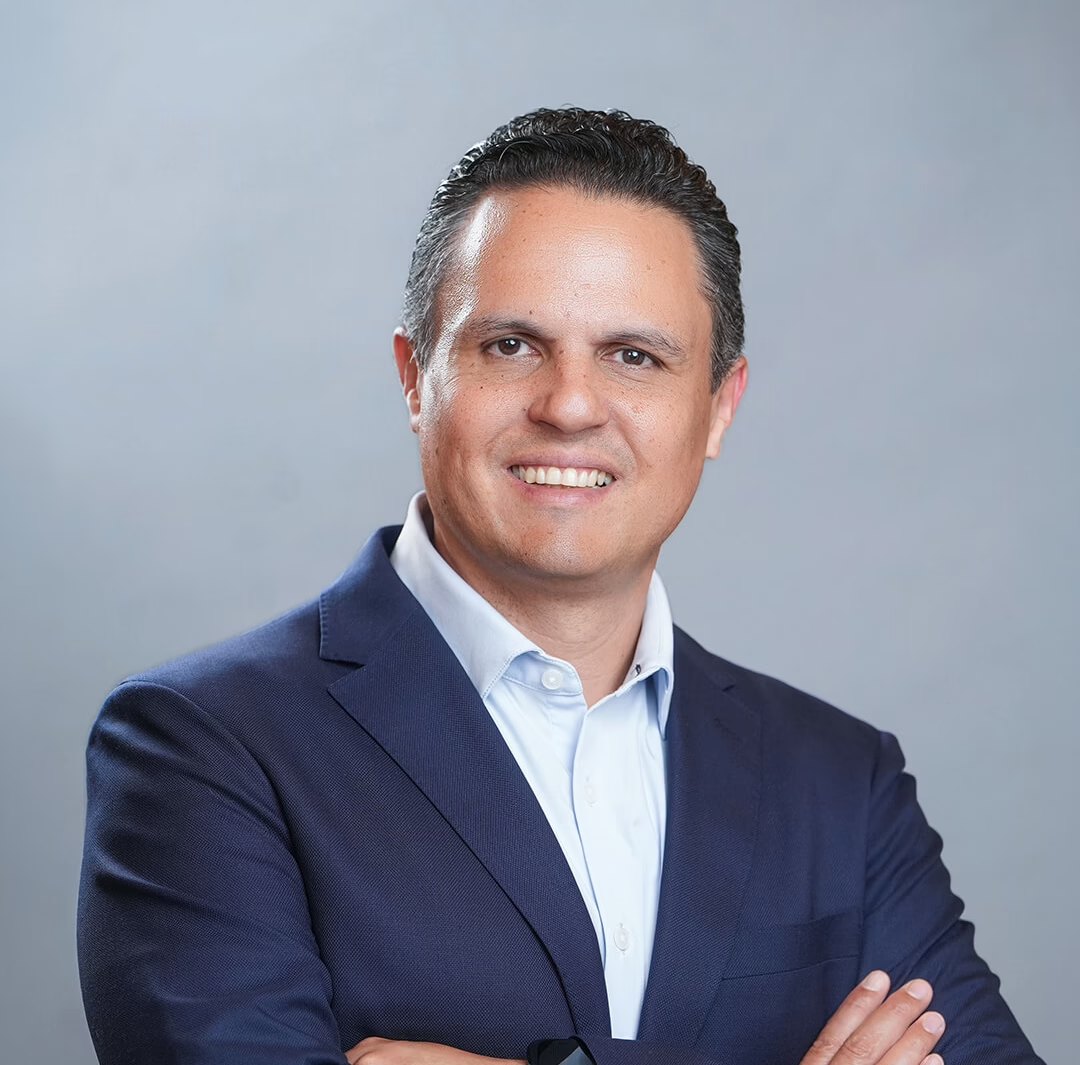

Francisco Leon occupies a rare position in corporate America: he is the only Hispanic CEO of a major publicly traded oil and gas company in the United States – a seat he earned by rising through CRC’s own ranks, from financial analyst to CFO to CEO.
The label “first” tends to cling to him: first Latino at the helm of this company; first to stand up a commercial-scale carbon capture and storage business in California; first to pair an oilfield with a data center campus in the Central Valley. Leon understands why that matters, but he’s also a little tired of that being the whole story.
“We have to get past the first-and-only phase,” he says. In sports, he points out, icons like Fernando Valenzuela and Julio César Chávez were once outliers; now there’s a steady stream of Mexican stars, and the pipeline is the point. In corporate America—and especially in energy—he doesn’t see that same bench. “The glass ceilings have been broken,” Leon says. “Now the test is whether we can bring a whole cohort through behind us.”
At CRC, Latinos make up nearly 40 percent of the workforce, a near match for the state’s demographics. The company’s leadership roles — from his national energy work to his involvement with Hispanics in Energy — double as scouting and development ground. The goal isn’t to celebrate one breakthrough hire; it’s to make the pipeline so consistent that the next one barely registers as news.
Local Molecules, Local Trust
Leon’s case for local energy has sharpened over the past few years. He’s more willing now to talk plainly about what he sees as California’s contradictions.
On paper, the state celebrates some of the strictest environmental standards in the world. In practice, it is importing more and more of the energy it uses, from crude moving through global chokepoints to power generated over state lines, even as it tightens the screws on local producers that already play by tougher rules.
To Leon, that isn’t a small policy wrinkle; it’s a missed chance for the communities where CRC operates. Local production, he says, brings three advantages at once: lower transport and energy costs for consumers, closer oversight of environmental impacts, and steady, well-paid jobs.
“If consumers could see a label on their energy the way they see ‘organic’ in the grocery aisle, they’d understand the value of something produced under California standards,” the CEO says. Instead, most people only think about energy when the price at the pump jumps or the lights flicker. He compares his crews to offensive linemen—easy to overlook until something fails—and sees part of his job as making that line visible and human.

Repurposing the Ground Beneath California & Existing Industrial Land
Carbon TerraVault I, CRC’s flagship carbon capture and storage (CCS) project, has already been covered as a historic milestone for California. What interests Leon now is what can be built from here.
The project uses a federal U.S. Environmental Protection Agency permit to take emissions from industrial sources and inject them a mile underground into a depleted oil and natural gas reservoir, a formation that once held oil and gas and now works as a vault to safely and permanently store carbon dioxide. The goal is to use the same geology that has stored hydrocarbons for millions of years to lock away the greenhouse gases of a modern economy.
Leon is quick to say the technology isn’t brand-new. What’s different is deploying it at scale in a state with some of the most ambitious climate goals in the country and a political culture that has, at times, treated his industry as expendable. Looking at California’s race to net-zero by 2045, he boils it down: heavy industry can either capture carbon or shut down. CRC’s bet is that carbon capture can keep those facilities, and the jobs tied to them, alive while still hitting the state’s targets.
CCS is only one layer, though. With the Golden Valley Technology Hub project, a proposed data center on an existing industrial site miles outside of Bakersfield, Leon is trying something less familiar: bringing the data economy into the same communities that have long powered California’s energy economy. The aim is to pair an oilfield operator’s experience with land, power, and permitting with the demands of hyperscale computing, and to do it without adding pressure on local water supplies or monthly power bills.
“Data centers are facing real pushback over water usage and grid strain,” Leon says. “Golden Valley is our test of whether an energy company with deep local roots can do it differently—low water usage, no incremental cost to ratepayers, and a clear apprenticeship and education pathway into the jobs that follow. In a region where large industries have historically boiled down to farming and oil, we’re bringing Silicon Valley down into the Central Valley.”
Politics as a New Language
For most of his career, Leon lived in the world of spreadsheets and deal sheets. When he moved from CFO to CEO, he had to pick up a very different language: the rhythms of state politics and the debate around an industry that some lawmakers openly said they wanted gone.
Over the last three years, he has pushed to recast CRC—and, by extension, much of what’s left of California’s oil and gas sector—as a local operator trying to balance affordability, reliability, and emissions at the same time.
Broader trends have helped his case. Rising energy costs and worries about grid stability have chipped away at some of the more rigid positions in Sacramento. Still, Leon will tell you that without years of quiet groundwork (visits, conversations, and a lot of listening) CRC would never have had the room to run with projects like Carbon TerraVault and Golden Valley.
Pressure, he’ll also tell you, is where he feels most at home. “I think it’s the same instinct that had me asking for the ball at the end of a football game in high school,” Leon says. “My coaches first saw my leadership in how I practiced and carried myself, not in motivational speeches. Now the stakes aren’t measured in scores but in stock price, jobs, and the resilience of California’s energy system.”
Francisco Leon is the latest guest on The Latino Majority podcast. Listen to the episode below or wherever you get your podcasts!
