
The other day, Thalia’s ‘Mujer Latina’ came on my playlist during my drive to work (if you know, you know).
Somewhere between dancing badly in my seat and reflecting on the lyrics, I started thinking about what it actually means to be Latino today. The song is a joyful, high-speed, pop-salsa celebration of Latin pride and feminine strength and it got my creative juices flowing.
I expect that most people will automatically have some preconceived ideas about me based on this Latino identity.
“He’s Latino, he must be a great dancer!”. I am decidedly not!
“He’s Latino, he must be an immigrant!” I am; almost professionally so!
“He’s Latino, he must have a large family.” I do not.
“He’s Latino, he must speak Spanish.” Sí señor! (I even know the keyboard shortcut for the ñ 😊).
Thalia’s song does a very subtle thing. The song is a quasi-autobiographical representation of her career as a Mexican artist. The lyrics talk about her pride of being Latina and go on to describe where she comes from; albeit in figurative ways (after all that is what poetry is for), but she never dives into defining her “Latinhood”.
Vengo de raza y de palmera,
De campo y de labriego,
De caña y de madera.
I come from people and palm tree,
From field and farmworker,
From sugarcane and from wood.
Where you come from and who you are are two very different things.
So, what does it mean to be Latino today? It means precisely one thing… and paradoxically, a plethora of different things at once.
If someone tells you they are Latina, Latino, or Latinx, you know they have Latin American roots. That’s it!
Everything else you think you know about them may simply be an assumption shaped by stereotypes, media bias, or political narratives.
What does it mean to be Latino today? I don’t know, because the Latino experience is not one experience.
After all, how can one word tell you everything there is to know about upwards of 670 million people, practicing literally thousands of different religious traditions, with an estimated 500-700 living languages, spread out across 20 countries, and two continents.
It can’t!
My experience in the US is when you say Latino, people immediately understand Mexican. But that is because I lived in areas where the majority of the migration has been from Mexico. I expect that in New York, Latino means Puerto Rican or Dominican, and that in Miami, it means Cubano. But again, those are my perceptions based on stereotypes and the media I consume.
The history of Latin America is deeply complex and it is shaped by colonialism, slavery, migration, politics, religion, and vastly different national experiences.
There are leftist regimes like Cuba and Venezuela (current situation notwithstanding) and you have countries with deep right wing, even fascist streaks like Argentina. You have the cripplingly corrupt history of Haiti and Honduras, with one of the least corrupt countries in the world, Uruguay. You have profoundly religious and conservative countries like Paraguay, and very liberal countries like Chile.
If you need any further convincing of the rich tapestry of Latin identities, do a deep dive on Tamales. There are literally hundreds of different types of tamales accentuating the various traditions and flavors of the people, from the United States all the way down to the Southern Cone.
So once again, what does it mean to be Latino?
I can speak about my thoughts and my feelings about my experience. And that may resonate with other people’s life journey; but my experience is mine and it won’t help you define or measure my level of “Latinhood” or of others.
So maybe that is one common thread for Latinos. Once we are labeled as one, we are then bestowed the undue burden of answering and being responsible for the actions and words of all other Latinos.
If you actually read this far, then ironically, this article was probably not news at all for you. If you’ve read this far, then there is a good chance you are living with this burden already or you are naturally curious and you are actually looking to engage with people on a personal level, not in a transactional and superficial way. But, if by chance you’re new to that concept, I offer a simple challenge: Be curious and accepting!
Identities color us! They inform and influence how we behave and how we interact with other people. They shape the type of tamale you like and whether you roll your Rs or not. They, however, are not a deterministic trait that obligates us to one action or another. They should enrich our lives, not separate us.
Perhaps, that is why Pablo Neruda’s “Too Many Names”. resonates with me.
This means that we have barely disembarked into life, that we’ve only now just been born, let’s not fill our mouths with so many uncertain names, with so many sad labels, with so many pompous letters, with so much yours and mine, with so much signing of papers. I intend to confuse things, to unite them, make them new-born, intermingle them, undress them, until the light of the world has the unity of the ocean, a generous wholeness, a fragrance alive and crackling.
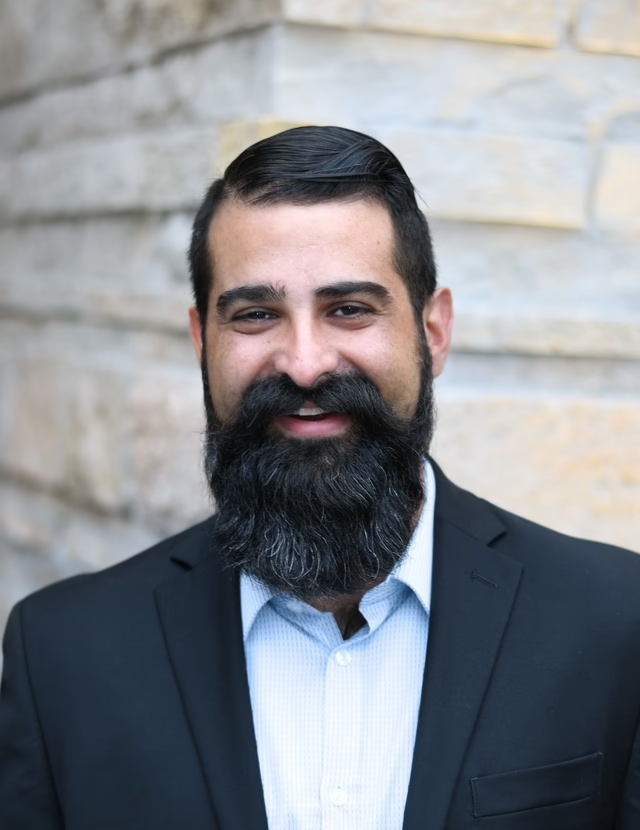
Gabriel A. Gomez is a Latino immigrant, US Marine Corps veteran, and service executive with more than 25 years of leadership experience. Throughout his career, he has worked to build high-performing teams while exploring the intersection of identity, culture, and leadership. Based in Charlotte, North Carolina, Gabriel writes about leadership, belonging, and the value of genuine human connection.
Keep up with Gabriel Gomez HERE!