

“Equal and exact justice to all men.”
— Thomas Jefferson, First Inaugural Address, 1801
The 2024 election revealed something important about America. Millions of working people wanted change. They wanted secure borders, safer communities, stronger American industries, better jobs, and an economy that rewarded hard work. For many in construction and the skilled trades, those expectations influenced how they voted.
This isn’t about questioning that decision or assigning blame. It is about asking a harder question: What do we do when the consequences of a policy begin to look different from what many of us expected?
Many Americans understood increased immigration enforcement to mean prioritizing dangerous criminals and individuals who presented genuine threats to our communities. Yet the available data paints a more complicated picture. Analyses of ICE detention data have found that large numbers of those detained have no criminal convictions. We have also seen reports of U.S. citizens being detained or caught up in enforcement actions, along with families and communities experiencing fear and disruption.
At some point, we have to acknowledge when implementation has moved beyond what many believed was the original intent.
Jefferson’s call for “equal and exact justice to all men” remains relevant more than two centuries later. Justice requires laws and secure borders. But justice also requires judgment—the ability to distinguish between someone who threatens our communities and someone who has spent years working, raising a family, building a business, and contributing to one.
For construction, the consequences are particularly significant. Immigrants represent more than a quarter of America’s construction workforce and roughly one-third of construction trades workers. In states such as California, Florida, Texas, Nevada, and New York, the percentages are considerably higher. In several critical trades—including roofing, painting, drywall, and plastering—immigrant workers represent more than half of the workforce.
These aren’t simply immigration statistics. They represent America’s capacity to build.
America already faces a shortage of skilled construction workers while simultaneously trying to build more housing, infrastructure, factories, semiconductor plants, energy projects, and data centers. Removing productive workers from an industry that already doesn’t have enough people creates consequences that eventually reach all of us through higher costs, longer schedules, fewer homes, and reduced economic capacity.
This isn’t an argument for open borders or against enforcing our laws.
It is an argument against indiscriminate and shortsighted policy.
Secure the border. Remove violent criminals and those who genuinely threaten our communities. But let’s also recognize the workers, parents, business owners, and long-standing members of our communities who contribute to this country. And when American citizens themselves become caught up in enforcement actions, we should be willing to acknowledge that something has gone wrong.
Construction must also offer solutions. Expand apprenticeships. Invest in American workers. Introduce young people to the trades earlier. Create legal workforce pathways that reflect our economic needs. Help workers advance from laborer to tradesperson, supervisor, contractor, and ultimately business owner.
This isn’t about regretting how someone voted.
It’s about recognizing unintended consequences when we see them and having the courage to adjust.
We know America needs more builders, not fewer. We know workforce capacity takes years to develop and can disappear quickly.
And we know a strong country can enforce its laws without abandoning judgment, fairness, or humanity.
Now you know.
The question is what we choose to do with that knowledge.
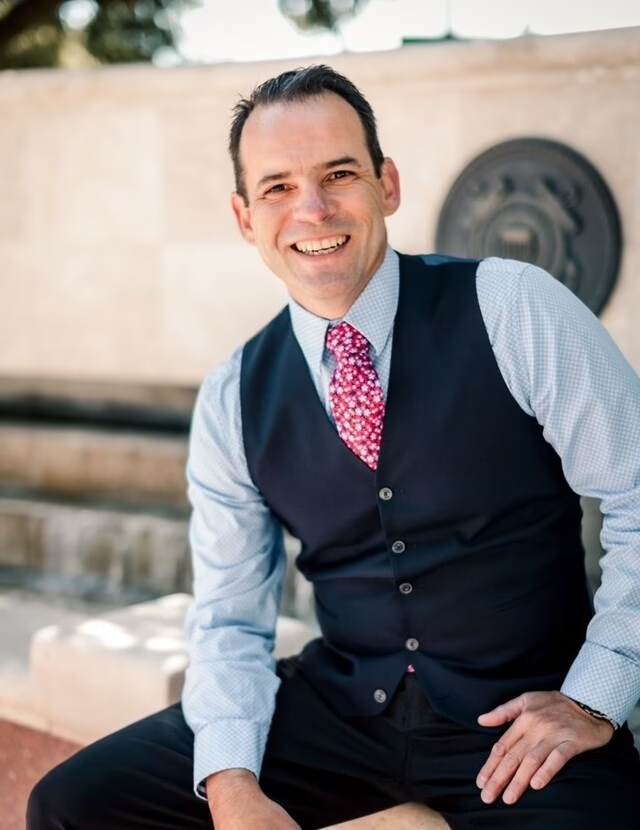
Sergio Barajas is the executive director of the National Hispanic Construction Alliance, where he leads the organization’s work to expand capacity building, access to capital, and business opportunities for Hispanic contractors and construction professionals. Over a 30-year career spanning housing development, construction, and financing, he has held roles with the National Association of Hispanic Real Estate Professionals, Freddie Mac, the National Community Stabilization Trust, and the Los Angeles Housing Department. Based in San Diego, California, Sergio writes about workforce development, advocacy, and the role of the Hispanic construction workforce in building a stronger and more equitable industry.
Keep up with Sergio Barajas HERE!