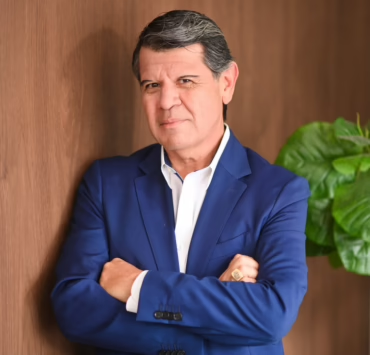

Andro Herrera-Mendoza says PAM Health fully recognizes that the way healthcare is utilized by patients is evolving. As senior vice president and chief innovation officer (his seventh promotion upon coming to PAM in 2018), Herrera-Mendoza is driving innovation at the organization that is centered, firmly, in the belief that sometimes tech is the answer and sometimes it is not, but what matters most is how to improve care and access PAM patients, particularly those patients who need longer-term care and monitoring.
“We’re talking about individuals with conditions that have been building for years,” he says. “The question is how do we stay relevant to them across that entire journey, not just for a few days in a hospital bed?”
PAM Health operates in the post-acute care space, one that most people never think about until they or a loved one land there. These are patients who often blow past the average 4.5‑day hospital stay and then need weeks of ongoing, high‑acuity support.
“Once someone’s been in a hospital, there’s a significant chance they’ll go to some kind of post‑acute setting,” Herrera‑Mendoza explains. “That could be a long‑term acute care hospital, inpatient rehab, a skilled nursing facility, home health, or even hospice. It’s a continuum, not a single stop.”
The clinical picture is getting tougher. Aging Americans with two or more chronic conditions are colliding with a younger population—millennials and Gen Z—who are developing serious health issues earlier than previous generations. The result is a steady flow of patients with neuro‑related disorders, musculoskeletal problems, autoimmune conditions, and movement disorders arriving sicker and staying longer.
Hospitals are responding by building for complexity, fewer low‑acuity cases, and more high‑acuity patients who need longer stays and carefully managed discharges. That only works if there are reliable partners downstream.
“If you don’t have strong post‑acute options, you don’t have beds,” he says. “You can’t keep admitting complex patients if you can’t safely move them to the next appropriate level of care.”
When Coverage Isn’t Access
The clinical side is only half the problem. The other half is who pays.
In Herrera‑Mendoza’s world, government programs, employers, and patients themselves are all looking for care in the appropriate setting. The stark reality is that often means sourcing options less expensive than a hospital. That tension plays out most visibly in prior authorization and network negotiations.
The SVP is blunt about how that can feel on the ground.
“Imagine your kitchen pipe bursts and you need a plumber,” he says. “Now imagine someone has to ‘pre‑authorize’ the repair before the plumber can even show up. That’s what healthcare looks like at times.”
Today, health plans often rely on algorithms and AI to approve or deny services in seconds. The reviewer may not share the clinical expertise of the specialist requesting the procedure. Many denials are later overturned on appeal, but by then treatment has been delayed.
“You may catch a few bad actors, but you’re also holding up a lot of necessary care,” Herrera‑Mendoza explains. “The delay alone can make a condition worse, and more expensive to treat.”
“We are thrilled to partner with Andro and PAM Health, an organization that shares our commitment to innovation and patient-centered care.” Says Brit Pim, President & CEO at Healix Infusion Therapy, LLC. “By combining Healix’s infusion expertise with their patient-focused care, we aim to set a new standard for delivering specialized care that truly meets patients where they are.”
The Opportunity to Innovate
Given his title, people assume Herrera‑Mendoza sits in a lab testing the latest and greatest tech advances. That’s not how he sees the job anymore.
“When I first moved into innovation, the question was, ‘What tech are you working on?’” chief innovation officer says. “Now the question is, ‘Can people actually use their coverage when they need care?’ Coverage is not the same as access.”
For PAM Health, innovation means redesigning how and where patients move through the system. That includes moving services like infusions out of hospitals and into home or near‑home settings when it’s safe to do so.
“Let’s be honest: People want to be in their own homes,” he says. “You’re more comfortable, you feel more in control. Our challenge is to bring a high level of care into that environment.”
Doing that at scale is the challenge. The organization must rethink everything from staffing to logistics. How does PAM route clinicians and equipment through multiple communities in twenty-three states without letting costs spiral?
The Inspiration for Care
Herrera‑Mendoza’s perspective is particularly important as he’s made the jump from caregiving himself.
As a teenager in San Antonio, he volunteered at the state chest hospital during the era of tuberculosis wards. He remembers a toddler in a crib, alone for long stretches while nurses and staff moved in and out. One day he brought her a stuffed bear because she had no toys in sight. The image stayed with him.
“Looking back, that may have been the first moment I really understood what it means to need care and not have much around you,” he says.
The night he graduated high school, he joined the US Navy and trained as a respiratory technician, eventually working as a respiratory therapist in ICUs, pediatrics, and neonatal units. After his service, he moved into a Level I trauma center with a children’s hospital, still at the bedside but quietly adding business and finance courses to his workload.
Today, at PAM Health, Herrera‑Mendoza is still trying to bridge worlds, patients and payers, hospitals and homes, clinicians and executives. The stakes are higher, the system more complex, but the throughline remains the same as it was in that San Antonio ward. The SVP wants to ensure that people don’t have to face serious illness alone and that the structures around them actually work when it matters most.
Healix is a leading provider of infusion services, specializing in physician-owned and ambulatory infusion centers nationwide. With over 35 years of expertise, Healix delivers patient-focused care, offering advanced treatments across specialties like infectious disease, neurology, and gastroenterology. Headquartered in Sugar Land, Texas, Healix delivers high-quality, safe, and seamless healthcare solutions.