

For years, when we talked about solving America’s housing shortage, the conversation almost always started with the same answer: we need to build more homes.
And we do.
But there is another opportunity sitting right in front of us—literally in our own neighborhoods.
We need to start thinking about how we can resize the housing we already have.
America’s housing stock is getting older. According to the National Association of Home Builders, the median age of an owner-occupied home reached 42 years in 2024, and nearly half of all owner-occupied homes were built before 1980. At the same time, families and the way we live are changing.
Young families need more bedrooms. Multigenerational families need additional living space. Older homeowners want to age in place. First-time buyers are often willing to purchase an existing home if they can renovate it into the home they actually need.
That is creating a significant shift in residential construction.
Remodeling is no longer simply about replacing a kitchen or updating a bathroom. It is increasingly about reconfiguring existing housing to meet the needs of today’s families.
The numbers tell the story. NAHB estimates that homeowners spent approximately $670 billion on remodeling in 2024, with about 20 million households undertaking improvements. Remodeling now represents roughly 45% of residential construction spending, and the sector is expected to continue growing.
Financing is also becoming an important part of this equation. Homeowners are using accumulated equity and products such as HELOCs to invest in the homes they already own rather than give up an attractive existing mortgage. The Federal Reserve Bank of St. Louis reports that the share of homeowners with housing debt using HELOCs increased 18% between early 2022 and early 2026.
For new buyers, renovation and acquisition-rehabilitation financing can create another pathway: purchase a home that may not perfectly fit today’s needs, then invest in making it work.
And this isn’t just a homeowner story.
Small builders, remodelers and developers are increasingly finding opportunity in existing neighborhoods. In 2025, more than $35 billion in residential transition lending financed the rehabilitation of existing housing stock, much of it in infill locations.
This is where the local construction community becomes so important.
The solution isn’t always a new subdivision. Sometimes it’s the house down the street.
The contractor who understands the neighborhood. The remodeler who knows how to transform an older floor plan. The lender who understands renovation financing. The architect, designer, tradesperson and developer who can see what an existing property could become.
These are the people who can turn existing housing into better housing.
And this is where the National Hispanic Construction Alliance (NHCA) and our members can play an important role.
Our chapters are local. Our contractors are local. Our relationships are local. We understand that housing solutions ultimately have to be executed one property, one family and one community at a time.
The future of residential construction will certainly include new homes. But it will also include rebuilding, remodeling, reconfiguring and reinvesting in the homes we already have.
We don’t just need to build more.
We need to make what we have work better for the families of tomorrow.
That’s the next opportunity—and it is already sitting in our neighborhoods.
Pico y Pala.
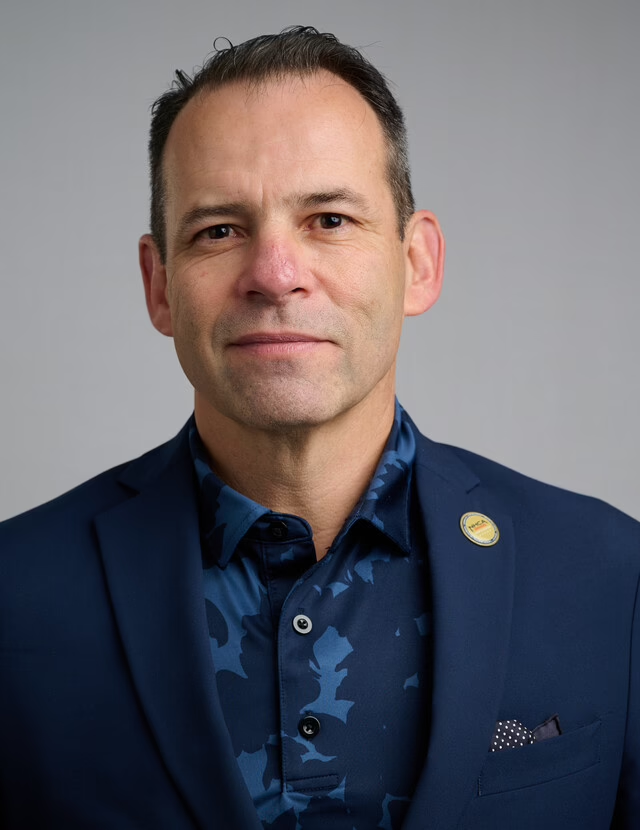
Sergio Barajas is the executive director of the National Hispanic Construction Alliance, where he leads the organization’s work to expand capacity building, access to capital, and business opportunities for Hispanic contractors and construction professionals. Over a 30-year career spanning housing development, construction, and financing, he has held roles with the National Association of Hispanic Real Estate Professionals, Freddie Mac, the National Community Stabilization Trust, and the Los Angeles Housing Department. Based in San Diego, California, Sergio writes about workforce development, advocacy, and the role of the Hispanic construction workforce in building a stronger and more equitable industry.
Keep up with Sergio Barajas HERE!