|
Getting your Trinity Audio player ready...
|
Elsa Luna came to ArtCenter College of Design in July of 2024 knowing full well that a tough moment was ahead. Enrollment numbers were down—across the higher-educational sector and across the nation—including ArtCenter. In her first few weeks as SVP and chief financial and administrative officer, Luna and the institution’s leadership were staring down a projected budget deficit narrowing in on $7 million. For an organization proud of its $140 million operating budget, the prospect of realizing approximately 10 percent, or $15 million, was as daunting as it was urgent.
This wasn’t Luna’s first go at large-scale challenges. The executive has made a life in nonprofit work, experiencing herculean financial challenges amid declining demographics (Southern California Public Radio took a major hit during COVID, with declining audiences now not listening on their commutes, and not really returning to radio since) and underserved communities (Los Angeles Universal Preschool). The SVP says her career wouldn’t feel worth it in the for-profit space, but that makes budget-cutting all the tougher.
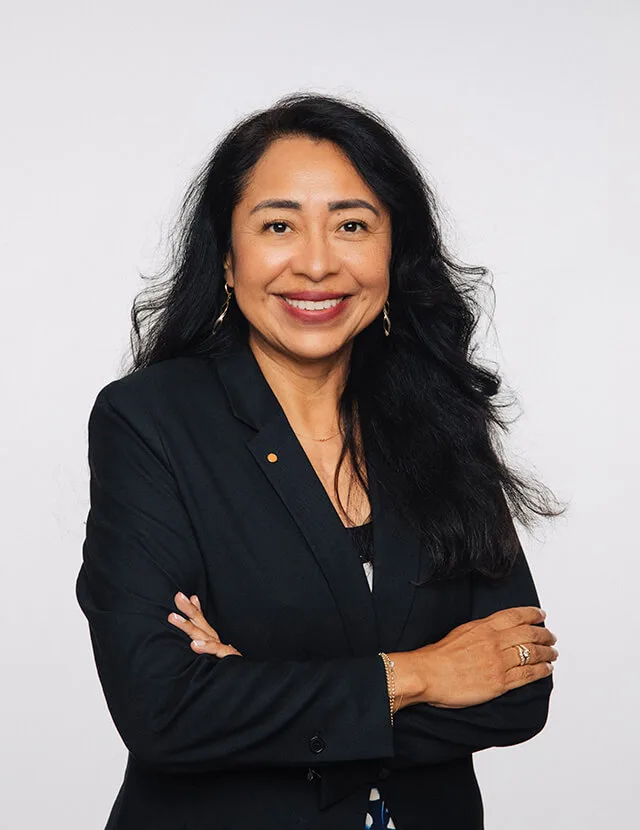
Within her first two months, Luna mapped out a multi-phase plan to steer ArtCenter toward financial stability by blending outside expertise with institutional engagement. She persuaded the organization to issue an RFP, ultimately bringing in Deloitte’s higher education division for a full examination of programmatic and financial workings.
It was Luna’s first time in the higher ed space, and while she felt motivated to move quickly, she also appreciated the very different landscape in which she was operating.
“Higher ed requires much more paced navigation. It moves at a more deliberate pace,” Luna says. “It’s like turning a cruise ship, not a speed boat. The study was going to take time, but we needed to start making moves in the interim.”
While Deloitte gathered data, Luna put her own analysis into action, starting cost-cutting measures and revenue-finding initiatives months before the full report arrived.
In all things, Luna says what has gotten her the furthest in her endeavors is a commitment to transparency. In delivery notes, not always upbeat or positive, she has been repeatedly complimented on being straight with her people. She has clearly laid out the problems, the potential solutions, and the realities of getting there.
Those realities are hard. “50 percent of our expenses are personnel,” Luna says. “I stood in front of our organization and told them that we would do absolutely everything we could before we had to eliminate jobs. And the reality is that there is only so much you can do before you confront the reality of your payroll. What I am proud of is that we did, indeed, do absolutely everything we could before getting to that point. I kept my word.”
The realities aren’t always easy. A voluntary resignation program was instituted, of which over a dozen people applied. Eventually, forty-eight jobs were eliminated.
“It was hard, and there’s no sense pretending that it wasn’t,” Luna says.
By the close of fiscal year 2025, ArtCenter had implemented a ten percent budget reduction, saving $15 million, and for the first time in years, operating with a balanced budget unassisted by reserve funds. This achievement extended a critical two-year runway for deeper programmatic innovation and revenue diversification, and perhaps more importantly, signaled to the college community that hard choices were not synonymous with permanent crisis. Luna says Deloitte’s partnership has offered up several potential strategies for combating enrollment challenges in the future.
Higher ed is in a tough spot across the board. College is becoming increasingly more expensive to operate, challenging for students to afford, with many thinking about college differently. It’s no longer a de facto move after high school. But should they want to pursue an art and design career, Luna wants students to have the choice of pursuing it at ArtCenter.
“I’m a native Angelino, and I am in love with this city and this region,” the executive says. “All I want to do is make this place better, however I can. I’ve been so impressed with the students and the faculty I’ve found here. They’re incredible people, and I just want to find ways for them to continue their paths, their missions, and their passions.”
Luna says important takeaways, both from previous experience and this one, have reminded her of the importance of repeating the message, whatever that message may be.
“To be clear, and to be transparent, you have to find as many ways of repeating your message over and over again,” Luna explains. “People sometimes hear what they want to hear. You don’t want them confused or caught off guard. You have to say it again and again, as many different ways as you can.”
The other lesson Luna continues to learn is just how grateful people can be, even when they’re hearing terrible news.
“I can’t tell you how many people thanked me, even when I was giving them bad news,” Luna says. “I tried to do it in the most respectful, most transparent way I could. But I certainly didn’t expect to be thanked for it.”
The good news is that ArtCenter’s mission continues. Luna knew it was going to be difficult, but she hasn’t built out a career in nonprofit work because it’s easy.
At Lockton, we offer something you may not be used to in insurance — creative thinking. No matter what challenge you face, we offer innovative solutions that are tailor-made for your business, even if we need to invent them anew.
Lockton helps companies understand and address critical risks through insurance and other strategies. Our sophisticated analytics, understanding of key insurance and risk management solutions, and expert market knowledge help companies optimize their risk capital, facilitate growth, and improve their bottom lines. Let us help you reach your ultimate potential.